
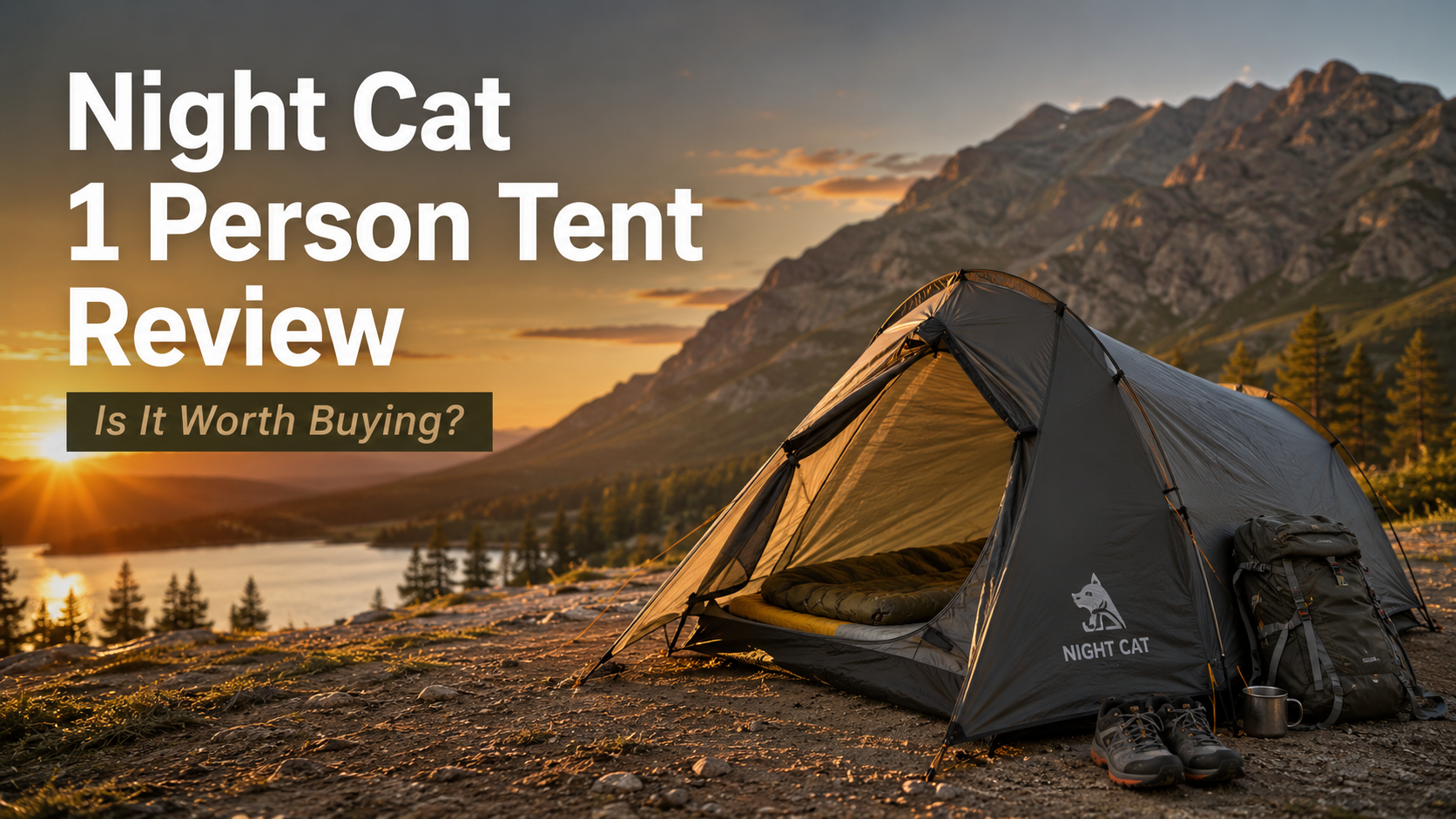
The Night Cat 1 Person Tent is worth considering if you want a roomy, easy-to-pitch solo shelter for casual camping, motorcycle trips, festivals, or short-distance backpacking. However, at its current listed price of $169.99 and packed weight of 4.4 pounds, it is difficult to recommend to weight-conscious backpackers. The tent provides more comfort and simpler setup than many minimalist solo shelters, but it is neither genuinely ultralight nor especially inexpensive compared with several established alternatives.
Worthflect rating: 7.3/10
Best for: Beginner solo campers, motorcycle campers, weekend hikers, and buyers who prioritize interior space over minimum weight.
Skip it if: You regularly hike long distances, camp above the tree line, expect severe winter weather, or want the lightest tent available for your money.
Important model note: This review focuses on the current Night Cat 1 Man Tent shown on Night Cat’s official product page, listed at 2 kg with pre-attached aluminum poles. Some older reviews online discuss a substantially lighter 1.05 kg Night Cat trekking-pole-style tent. Those comments may not accurately describe the current model.

The current Night Cat solo tent offers enough entrance and sleeping space for one adult without feeling like a narrow bivy shelter.
Night Cat 1 Person Tent Specifications
| Specification | Official information |
|---|---|
| Capacity | 1 person |
| Seasons | 3-season |
| Dimensions | 86.6 × 35.4 × 41 inches |
| Weight | 4.4 lb / 2 kg |
| Packed size | 16.1 × 6.3 × 6.3 inches |
| Floor width | Approximately 35.4 inches |
| Waterproof rating | 5,000 mm |
| Pole material | Aluminum |
| Included components | Tent, rainfly and stakes |
| Current listed price | $169.99 |
| Warranty | One year |
Night Cat describes this model as an ultralight backpacking tent, but its 4.4-pound weight places it closer to a comfortable traditional solo tent than a modern ultralight shelter. For comparison, the Naturehike Cloud Up UL 1 is listed at approximately 2.69 pounds packaged and $149, making the Night Cat roughly 1.7 pounds heavier while also carrying a higher regular price.
That does not automatically make the Night Cat a poor tent. It simply means buyers should choose it for convenience, usable space and a more supportive pole structure rather than for minimum trail weight.
Design and Build: More Substantial Than the “Ultralight” Name Suggests
The current Night Cat 1 Person Tent uses a low-profile, external aluminum-pole structure that creates a relatively broad roof and steep enough sidewalls to make the interior feel more usable. The rainfly appears to cover the complete sleeping area, while a mesh inner body provides insect protection and airflow.
Its shape is somewhere between a compact dome and a tunnel-style solo tent. Unlike trekking-pole shelters, it does not rely on your hiking poles to remain standing. That makes the tent more approachable for beginners and more convenient at established campsites where the ground may not accept stakes perfectly.
The structure is also useful for motorcycle camping. A motorcyclist may be less concerned about saving every ounce and more interested in arriving at camp, pitching quickly and having enough interior height to change clothes. At 41 inches tall, the Night Cat gives most adults enough room to sit up near the center, although taller users may still brush the roof when moving around.
The materials and finishing appear appropriate for a midrange recreational tent, but buyers should keep their expectations realistic. This is not a premium expedition shelter designed to compete with tents from Hilleberg, NEMO, MSR or Big Agnes. Its appeal comes from combining a complete pole system, generous solo dimensions and a strong claimed waterproof rating in one relatively simple package.
Setup Experience: One of Its Strongest Advantages
Night Cat says the tent uses pre-attached aluminum poles and can be pitched by one person in minutes. Product images show the poles attaching to the exterior through clips and connection points rather than requiring the user to slowly feed long poles through fabric sleeves.
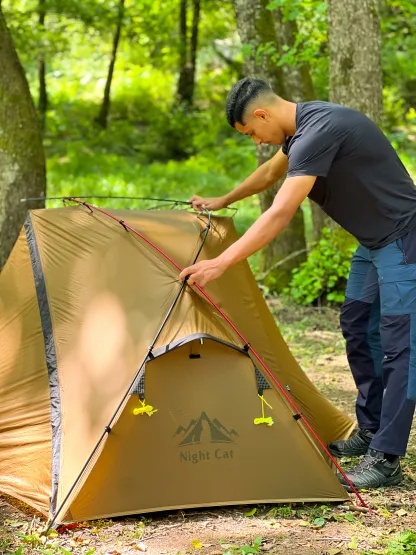
External clips and a connected pole structure should make the tent easier to assemble alone than many basic sleeve-pole tents.
This design should be especially valuable when you reach a campsite late, have limited daylight, or need to pitch during light rain. After using the tent several times, most owners should be able to identify the corners, extend the pole system, clip the body in place and tension the fly without studying the instructions.
The structure is still more complicated than an instant pop-up tent, but it packs much smaller and should provide better stability. It is also easier to understand than a non-freestanding trekking-pole tent, which requires careful stake placement, pole-height adjustment and tensioning.
Before taking it on a trip, set it up once at home. This allows you to confirm that every pole, peg, guy line and connection is present. It also gives you a chance to practice folding the pole system and fitting everything back into the storage bag.
Interior Space: Comfortable for One, Not One Plus Gear Everywhere
The official floor dimensions are approximately 86.6 inches long and 35.4 inches wide. That gives one adult enough room for a standard or wide sleeping pad, depending on the pad’s exact shape. The 41-inch peak height is also more generous than many low-profile solo backpacking shelters.

The floor accommodates a full-length sleeping pad while leaving limited space along the edges for smaller personal items.
For an average-size solo camper, the tent should feel noticeably more comfortable than a bivy-style shelter. You can sleep without your shoulders pressing against both walls, sit up to organize clothing and keep a phone, headlamp or water bottle near your sleeping pad.
The space becomes less generous once a thick rectangular pad is installed. A 25-inch-wide pad would leave roughly ten inches of total remaining floor width, divided between both sides. That is enough for small items but not a large backpack, boots, cooking equipment and several storage bags.
The vestibule or covered entrance should therefore be used for footwear and weather-resistant gear. Valuable electronics, insulated clothing and anything that must remain completely dry should stay inside the sleeping compartment in waterproof bags.
Campers over approximately six feet two inches should also consider the sloping walls. The stated floor length is generous, but usable sleeping length is usually shorter than the maximum floor measurement because sleeping bags and feet rise above the floor. Very tall campers may prefer a longer 1.5-person or two-person backpacking tent.
Weight and Packability: Portable, but Not Truly Ultralight
This is the area where the Night Cat’s marketing becomes less convincing. A 4.4-pound shelter can certainly be carried in a backpack, but it is heavy for a current one-person backpacking tent. Night Cat’s packed dimensions of 16.1 × 6.3 × 6.3 inches are reasonably compact, so volume is less concerning than weight.

The tent packs down neatly, although its 2 kg weight is better suited to short hikes, motorcycle travel and relaxed camping than serious ultralight backpacking.
For a one-night hike covering a few miles, the weight may be perfectly acceptable. It may also work well when the load is shared indirectly for example, when food and cooking equipment are distributed among several hikers.
The extra weight becomes noticeable on multi-day routes with long climbs. A shelter weighing around 2.5 pounds instead of 4.4 pounds can remove nearly two pounds from your pack immediately. That difference matters more than many small gear upgrades combined.
The Night Cat makes much more sense for:
- Motorcycle or bicycle trips where a complete pole system is convenient.
- Car camping when a large family tent feels unnecessary.
- Festivals and organized campsites.
- Short backpacking routes.
- First-time campers who value simple setup.
- Buyers who do not already own trekking poles.
Calling it “portable” is fair. Calling it “ultralight” is much harder to justify.
Waterproofing and Weather Protection
Night Cat lists a 5,000 mm water-resistance rating, waterproof fabric and fully taped seams. On paper, that rating is more than adequate for normal three-season rain. The tent’s bathtub-style floor also raises the waterproof lower material above ground level, reducing the chance of splashback or shallow surface water reaching the mesh.

The raised floor edges are designed to help prevent water from entering where the tent meets wet ground.
A waterproof rating alone does not guarantee a dry night. Fly coverage, seam quality, door design, ventilation, ground selection and correct guy-line tension all influence real-world performance. The tent should be pitched on slightly elevated ground rather than in a depression where rainwater can collect.
Some independent feedback available online criticizes rain protection, ventilation, condensation and weak included stakes. However, that review describes a lighter 1.05 kg version with an attached fly, while the current official tent is listed at 2 kg and shows a noticeably different pole and fly design. Those complaints are useful as a warning to test the tent before a remote trip, but they should not be treated as confirmed problems with the present model. (Trailspace)
The official page labels the current tent as a three-season model, despite displaying lifestyle imagery that includes snowy conditions. Buyers should follow the technical classification rather than the promotional photograph. This tent is intended for spring, summer and fall not exposed winter camps, heavy snow loading or severe alpine storms.
For windy weather, use every available guy line and replace the included stakes if they bend easily or fail to hold in loose soil. Carrying several stronger Y-shaped aluminum stakes would be a sensible, inexpensive upgrade.
Ventilation and Condensation
The inner tent includes large mesh areas, and the official images show ventilation openings at both ends. This should provide decent cross-flow when the entrance and vents are correctly positioned.
Condensation can still occur in any small one-person tent. A single sleeper releases moisture through breathing, damp clothing and wet equipment. When the exterior temperature drops, that moisture can collect on the cooler inner surface of the rainfly.
To reduce condensation:
- Keep the vents open whenever weather allows.
- Avoid pressing the inner mesh against the fly.
- Do not store soaking-wet clothing beside your sleeping bag.
- Pitch where a light breeze can reach the vents.
- Tension the fly so there is a clear air gap between both layers.
The relatively broad mesh panels make this Night Cat tent better suited to mild and warm weather than cold, exposed conditions. During cooler nights, good ventilation may feel drafty, but closing everything tightly can increase moisture buildup.
What the Night Cat Tent Does Well
The most convincing part of this tent is its balance of interior comfort and setup simplicity. It gives a solo camper enough room to sleep on a proper pad, sit upright and organize basic equipment without adopting the highly minimalist routine required by smaller ultralight shelters.
The external aluminum-pole design should also provide more predictable structure than a trekking-pole tent. You do not need to carry separate hiking poles or spend time achieving perfect tension before the shelter takes shape.
Its other advantages include a compact packed length, full mesh inner body, raised waterproof floor and an official 5,000 mm water-resistance rating. Night Cat also provides a one-year warranty covering product defects through repair or replacement.
Main advantages
- Roomier than many minimalist one-person tents.
- Straightforward solo setup.
- Complete aluminum-pole structure.
- Compact packed dimensions.
- Good peak height for sitting up.
- Full mesh inner sleeping compartment.
- Strong claimed waterproof rating.
- One-year manufacturer warranty.
Where It Falls Short
The 4.4-pound weight is the clearest disadvantage. Backpackers paying approximately $170 can already find tents closer to 2.5–3 pounds, including options from brands with longer histories in lightweight shelter design.
Value is therefore highly dependent on discounts. At a meaningful promotional price, the Night Cat becomes easier to recommend as a comfortable beginner tent. At the full $169.99 listing price, buyers should compare it carefully with lighter alternatives.
The official listing also provides limited technical detail about fabric denier, floor material, ventilation design and minimum trail weight. Those details matter to experienced backpackers who want to understand where the total weight comes from and how the tent may age after repeated use.
Main disadvantages
- Too heavy to qualify as genuinely ultralight.
- Full price is high relative to some lighter competitors.
- Limited long-term feedback for the current design.
- Only moderate storage space after installing a wide pad.
- Not intended for four-season or severe alpine conditions.
- Included stakes may eventually require upgrading.
- Official specifications could be more detailed.
Is It Worth $169.99?
At the full listed price, the Night Cat 1 Person Tent is acceptable rather than exceptional value.
Its space, simple pole structure and weather-ready design justify paying more than you would for an entry-level department-store tent. However, the 4.4-pound weight works against it. Naturehike’s Cloud Up UL 1, for example, is officially listed at $149 with a packaged weight of approximately 2.69 pounds, although material choices, interior shape and availability may differ. (Naturehike)
The Night Cat becomes more attractive when discounted below approximately $130–$140. At that level, the extra weight is easier to accept, especially for beginners who want a complete, supportive shelter rather than a highly specialized ultralight design.
Night Cat advertises free shipping on orders above $60 and states that its standard processing and shipping period can total approximately five to seventeen working days. Its policy also provides a one-year warranty, with refund or replacement options described for qualifying issues reported within 30 days of delivery. Buyers should confirm the latest conditions before placing an order.
Who Should Buy the Night Cat 1 Person Tent?
Buy it when your priorities are:
- Comfortable solo space: You want room for a proper sleeping pad and basic personal gear.
- Easy setup: You prefer a dedicated pole system over trekking poles and complex tensioning.
- Short-distance travel: Your campsites are not reached through long, high-mileage hikes.
- Motorcycle camping: Packed size matters, but a few extra pounds are manageable.
- Beginner-friendly equipment: You want a conventional design that is easy to understand.
- Three-season recreation: Most trips take place in established sites during moderate weather.
Who Should Choose Something Else?
Consider another tent when:
- You routinely walk more than ten miles per day.
- Your complete backpack weight is a major priority.
- You expect heavy snow, extreme wind or exposed mountain conditions.
- You need enough space to keep a large backpack inside.
- You want extensive independent field testing and a long-established repair network.
- You already own trekking poles and are comfortable pitching a non-freestanding shelter.
Final Verdict
The Night Cat 1 Person Tent is a practical solo shelter with a good amount of usable space, approachable setup and promising three-season protection. It is significantly more comfortable than a minimal bivy tent and should work well for weekend camping, motorcycle adventures, festivals and short backpacking routes.
Its main weakness is not construction it is positioning. A 4.4-pound one-person tent should not be marketed as truly ultralight, especially when lighter competitors are available for similar or lower prices. Buyers who understand that trade-off may still enjoy the tent, but long-distance hikers will probably regret carrying the extra weight.
Worthflect recommendation: Buy it during a strong sale when convenience and interior comfort matter more than pack weight. At the full $169.99 price, compare lighter alternatives before ordering.
Overall score: 7.3/10
- Setup: 8.5/10
- Interior comfort: 8.2/10
- Weather protection: 7.6/10
- Portability: 6.4/10
- Value at full price: 6.5/10
Check the current product details:
Frequently Asked Questions
Is the Night Cat 1 Person Tent really ultralight?
Not by current backpacking standards. The official weight is 4.4 pounds, while many modern solo backpacking tents weigh around two to three pounds. It remains portable, but “lightweight recreational tent” would be a more accurate description.
Can two people sleep in it?
It is officially designed for one person and has a floor width of approximately 35.4 inches. Two adults would not have enough comfortable shoulder or sleeping-pad space.
Is it waterproof?
Night Cat claims a 5,000 mm water-resistance rating, waterproof fabric and taped seams. That specification should be sufficient for normal three-season rain when the tent is properly pitched, although buyers should test the shelter before relying on it in remote conditions.
Is it suitable for winter camping?
No. Night Cat officially categorizes it as a three-season tent. Promotional snow imagery should not be interpreted as proof of four-season performance.
How long does it take to set up?
Night Cat states that one person can assemble it in minutes. The pre-attached aluminum pole structure and exterior clips should become quick to use after one or two practice attempts.
Does the Night Cat tent have a warranty?
Yes. Night Cat states that products are covered by a one-year warranty against qualifying defects, generally through repair or replacement rather than an automatic refund.


Leave a Reply