

Worthflect Verdict
Night Cat tents are worth buying for budget-conscious campers who prioritize fast setup and practical space over premium materials or expedition-level protection.
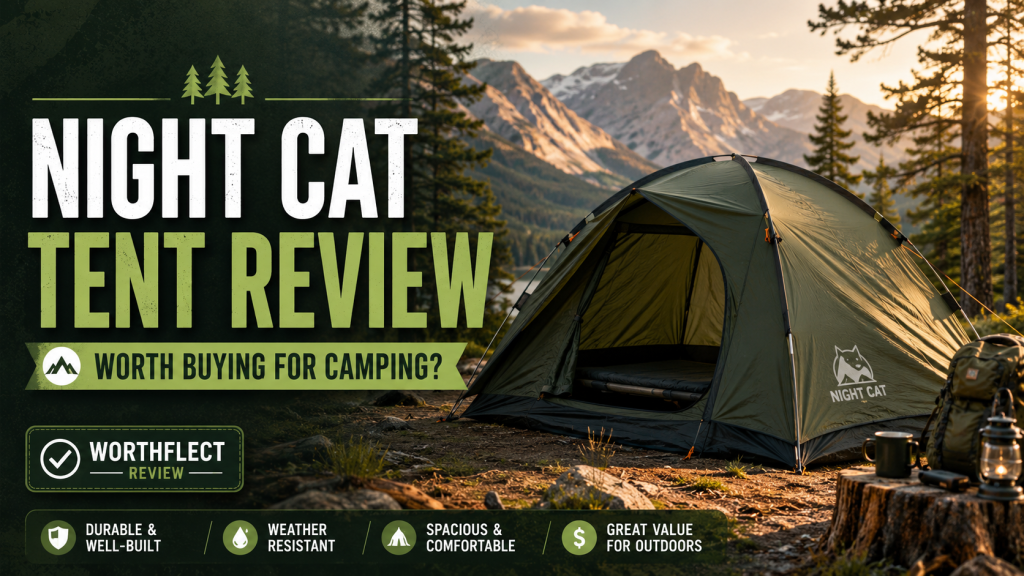
The brand is particularly attractive for car camping, festivals, fishing trips, backyard camping, and occasional weekend use. Its pop-up models remove much of the stress involved in pitching a tent, while its conventional backpacking models offer useful waterproof specifications at accessible prices.
However, most Night Cat tents are not ideal for exposed mountain camps, heavy winter weather, or long-distance backpacking. Pop-up frames trade wind resistance for convenience, and their circular carry bags are awkward to attach to a hiking backpack.
Overall Worthflect rating: 4.0 out of 5.
| Category | Worthflect Rating |
|---|---|
| Ease of setup | 4.8/5 |
| Space and comfort | 4.1/5 |
| Rain protection | 3.9/5 |
| Ventilation | 3.7/5 |
| Build quality | 3.6/5 |
| Portability | 3.5/5 |
| Value for money | 4.3/5 |
Review note: This assessment is based on Night Cat’s published specifications, warranty information, independent field reports, and publicly available owner feedback rather than a controlled laboratory test.
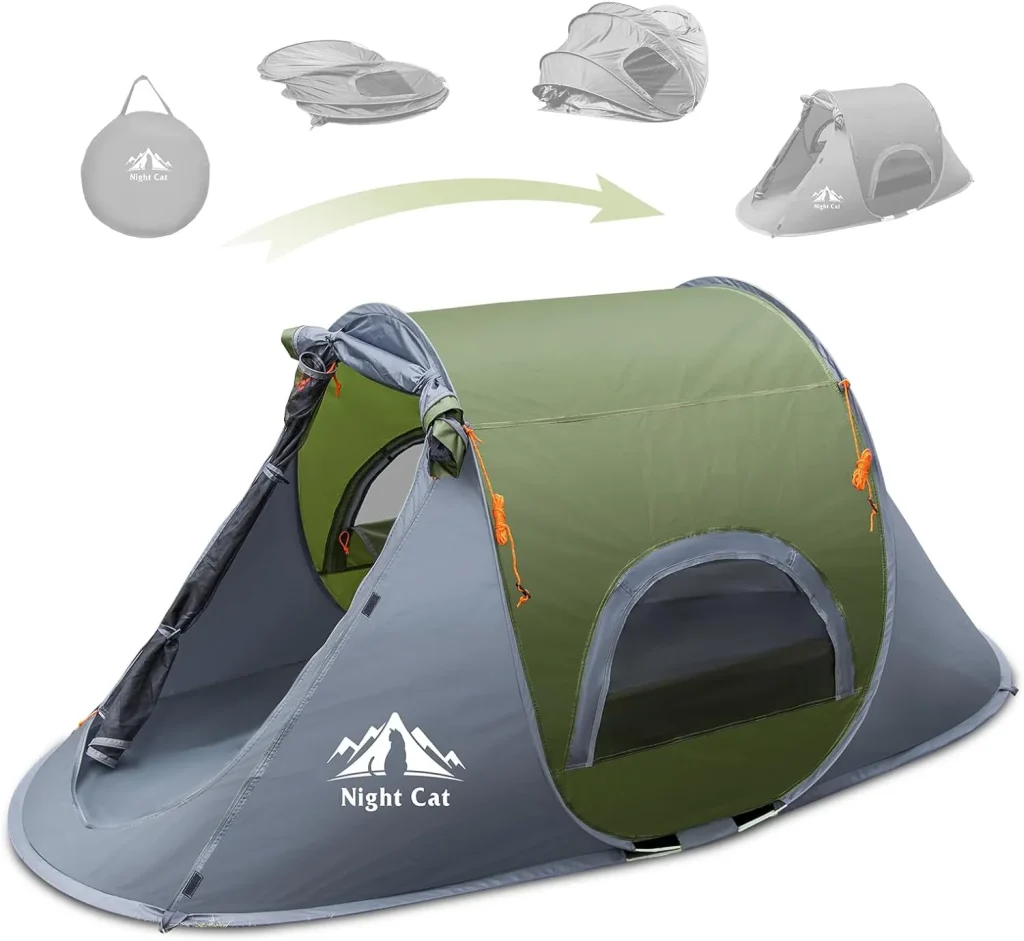
Caption: The Night Cat one-person pop-up tent emphasizes near-instant deployment and enough floor space for one adult, a sleeping pad, and essential gear.
Which Night Cat Tent Is This Review About?
Night Cat sells several different tent types, so it would be misleading to judge the entire brand as though it produced only one model. Its current range includes throw-style pop-up tents, hydraulic instant tents, conventional pole-supported backpacking tents, trekking-pole ultralight shelters, tunnel tents, and larger family tents.
At the time of writing, the basic one-to-two-person backpacking tent was listed at $49.99, the one-person pop-up at $69.99, the double-layer instant model at $123.99, and the three-person cabin tent with canopy at $159.99. Prices and availability may change.
The best choice depends on how you camp:
- Fast solo campsite setup: One-person pop-up tent
- Affordable conventional shelter: One-to-two-person backpacking tent
- Best balance for couples: Double-layer hydraulic instant tent
- Best for small families: Cabin tent with detachable canopy
- Best for hiking: Dedicated ultralight trekking-pole model
Setup: Very Fast, but Not Completely Effortless
Setup is the strongest reason to choose a Night Cat pop-up tent.
Night Cat says its one-person model opens in approximately three seconds after being removed from the bag and released. That claim describes the tent body opening not the entire campsite setup. You must still position the tent, stake the corners, attach or tension the guylines, and arrange the entrance before it is properly secured.
The larger instant model uses a central hydraulic-style mechanism. You extend the frame and lift the central hub instead of threading traditional poles through fabric sleeves. It is especially convenient when arriving after dark, supervising children, or setting up while rain is beginning.
An independent field report of a larger Night Cat pop-up found that the tent body opened within seconds and could be pitched alone in poor light. The reviewer’s experience supports Night Cat’s main selling point: less time struggling with poles and more time organizing the campsite.
Packing the tent away requires more practice. The one-person model folds into a figure-eight shape before being folded again to fit its smaller circular bag. Some owners find the process manageable after practicing, while others complain that pop-up tents fight against being folded.
The sensible approach is to unfold and repack the tent several times at home. Do not wait until a windy morning at the campsite to learn the folding technique.
Interior Space: Use the Capacity Rating Carefully
Tent capacity usually describes how many sleeping mats can physically fit not how many people can sleep comfortably with luggage.
The Night Cat one-person pop-up has an internal area of approximately 7.7 by 3.3 feet and a height of about 2.95 feet. It can fit one adult, a narrow or twin-size sleeping pad, and some equipment beside the sleeping area. Its low height means it is mainly a sleeping shelter rather than a tent where an adult can stand or move around freely.
The hydraulic instant tent is marketed for two to three people and weighs approximately four kilograms. In practical terms, it makes more sense for two adults with equipment or three people packing lightly.
A separate field review of a Night Cat tent marketed for four people reached a similar conclusion: four mats could technically fit, but two people with gear provided the most comfortable arrangement, while three remained manageable.
For families, the cabin model offers a more livable design. Its inner floor measures 210 by 210 centimeters, with a height of 140 centimeters. Night Cat says it can accommodate a king-size air mattress, while the detachable canopy creates a shaded area outside the sleeping compartment.

Caption: The hydraulic instant model combines quicker setup with a conventional dome shape, separate rainfly, and included footprint.
Waterproofing: Suitable for Normal Rain, Not Extreme Weather
Night Cat’s published waterproof ratings are respectable for budget camping tents.
The one-person pop-up uses 190T polyester with a stated PU 2,000 mm coating, taped seams, pegs, and guylines. The basic backpacking model uses 210D polyester for the main body and 150D Oxford fabric for the floor, with both listed at PU 3,000 mm.
A 2,000–3,000 mm rating is useful for ordinary three-season camping, but the fabric rating alone cannot guarantee a dry night. Rainfly coverage, seam construction, floor condition, staking, fabric tension, campsite drainage, and wind direction all affect real-world performance.
Night Cat occasionally uses strong marketing language about remaining dry during storms. We would be more conservative. An independent reviewer found that a Night Cat pop-up performed adequately in moderate rain and light wind but did not recommend it for exposed hilltops or severe weather.
For normal campground rain, a properly pitched Night Cat tent should provide reasonable protection. For strong wind, prolonged heavy rain, snow, or exposed mountain terrain, a lower-profile tent with a stronger pole structure and fuller rainfly would be safer.
Use every guyline provided and place a correctly sized footprint under the floor. Make sure the footprint does not extend beyond the tent edges, as exposed groundsheet material can collect rain and direct it underneath the tent.
Ventilation and Condensation
The one-person pop-up has a large entrance and two wide side windows. Other Night Cat pop-up models use mesh doors and windows to improve airflow while keeping insects outside.
Ventilation is generally good when the weather allows the windows or outer door panels to remain open. The challenge appears during cool, humid, or rainy nights.
Several affordable Night Cat models use a single-wall or partly single-wall construction. Moisture from breathing can condense when warm interior air touches cooler tent fabric. This can create damp walls even when rain is not leaking through the material.
Some camping enthusiasts have specifically criticized throw-style pop-up tents for condensation and limited rainfly coverage. However, another field report found that the larger Night Cat pop-up’s mesh panels and multiple openings kept condensation at a manageable level during normal campsite use. (Camp Equipment Plus)
For humid climates or two occupants, choose a double-layer model. Keep upper vents open, avoid placing sleeping bags directly against the walls, and leave part of the door vented whenever conditions permit.
Material and Durability
Night Cat uses materials that are appropriate for its price rather than premium expedition-grade components.
The entry-level backpacking model combines polyester or Oxford fabrics, polyurethane waterproof coatings, fiberglass poles, mesh, and conventional stakes. Night Cat covers the fiberglass pole sections with a protective layer intended to reduce the chance of fiberglass splinters during assembly.
Fiberglass keeps the price down, but it is generally heavier and less durable than high-quality aluminum. This matters most in strong wind or after frequent pitching and packing.
The floor also deserves protection. One Night Cat owner questioned whether the relatively light floor would tolerate roots, stones, and hard ground. Another reported using a tarp underneath and found the tent easy to use after practicing the folding process.
A lightweight footprint is therefore a worthwhile addition. Clear sharp stones, branches, and pinecones before pitching. Most floor damage comes from abrasion or punctures rather than rain passing directly through undamaged coated fabric.
The throw-style frame is another compromise. Its flexibility allows the tent to spring open, but it does not provide the same stability as a well-designed structure with aluminum poles and several properly tensioned guy points. Some owners describe Night Cat pop-ups as acceptable for their price, while others report weak frames or disappointing long-term durability.
Portability: Lightweight Does Not Always Mean Backpack-Friendly
The one-person pop-up weighs approximately 1.5 kilograms, but its folded bag measures about 21 inches across. It is easy to carry from a vehicle to a nearby campsite, but the wide circular bag is inconvenient on a hiking backpack.
For festivals, road trips, fishing, motorcycle support vehicles, and short walk-in campsites, that shape may not matter. For a multi-day hike, it can become frustrating.
The conventional Night Cat backpacking tent packs into a more useful shape but weighs approximately two kilograms for the one-person version and 2.5 kilograms for the two-person model. It is acceptable for beginners and shorter hikes but is not ultralight by current backpacking standards.
Night Cat also sells dedicated trekking-pole shelters. Its ultralight collection includes a one-person model weighing approximately 1.08 kilograms without a trekking pole, although the price is significantly higher than the entry-level dome tent.
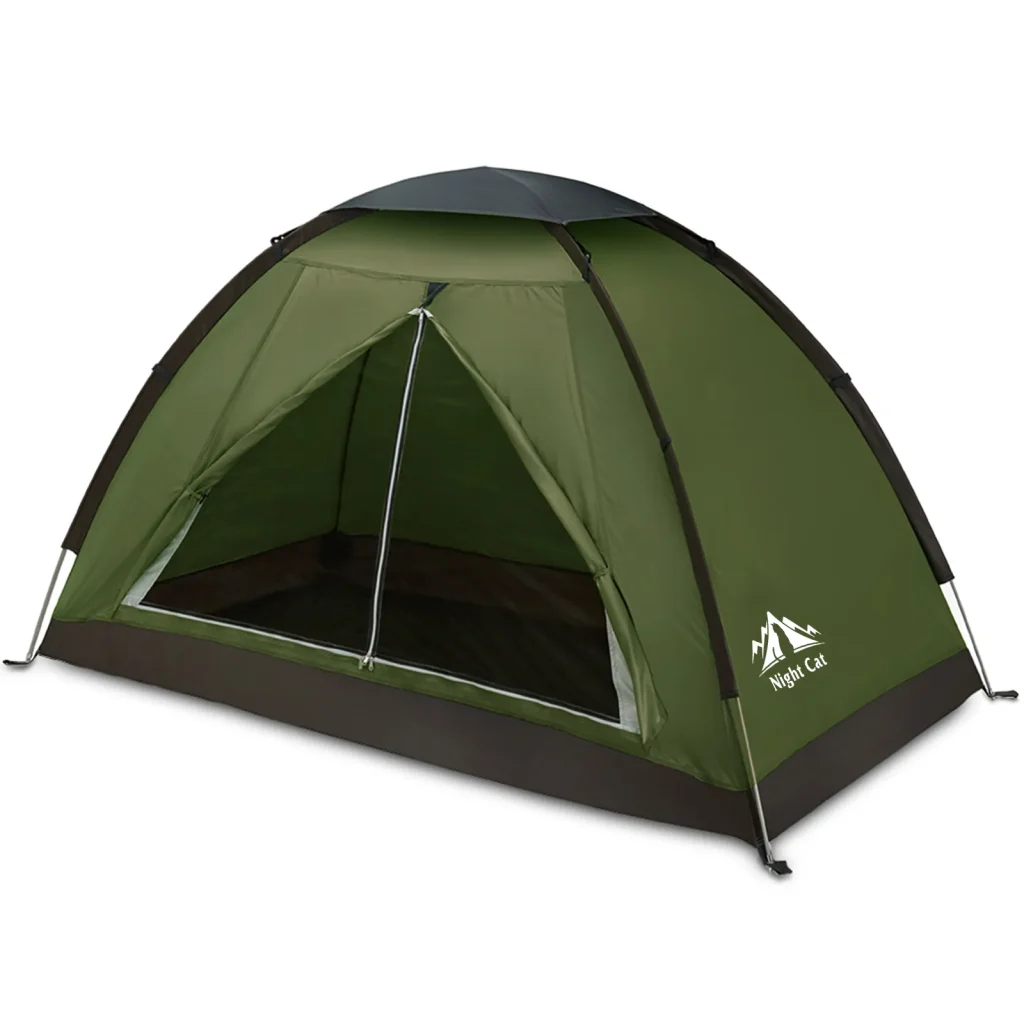
Caption: The conventional backpacking model takes longer to assemble than a pop-up tent but offers a more manageable packed shape for hiking.
Customer Support, Returns, and Warranty
Night Cat publishes a 30-day return window. Customers are instructed to contact the company before returning an item, provide proof of purchase, and obtain an approved return address. For returns unrelated to damage, defects, duplicate shipments, or seller error, the buyer generally pays the return shipping cost.
The company also advertises a one-year warranty covering defects through repair or replacement. After the initial return period, the warranty generally does not provide a refund.
Inspect the tent as soon as it arrives. Pitch it at home, test every zipper, check the seams and pole sections, and confirm that the stakes, guylines, footprint, and rainfly listed on the product page are present.
Public feedback about Nightcat.com is too limited to support a reliable overall conclusion about customer service. Trustpilot currently displays a 3.5 rating based on only four reviews, including one detailed complaint about a difficult hammock return. Because the sample is extremely small and not focused solely on tents, it should not be treated as representative. (Trustpilot)
Pay through a method offering buyer protection, retain the original packaging, photograph any defect, and receive return instructions in writing before shipping anything back.
Night Cat Tent Pros and Cons
What We Like
- Very fast deployment on pop-up and hydraulic models
- Competitive prices across multiple tent categories
- Useful 2,000–3,000 mm published waterproof ratings
- Taped seams on many models
- Good campsite space for the price
- One-year repair or replacement warranty
- Several choices for solo campers, couples, and families
What Could Be Better
- Pop-up tents require practice to fold
- Circular carry bags are unsuitable for serious backpacking
- Capacity descriptions can feel optimistic
- Single-wall models are more vulnerable to condensation
- Fiberglass frames are less robust than premium aluminum poles
- Pop-up structures are not intended for demanding weather
- Buyer-paid return shipping may be expensive
Which Night Cat Tent Should You Buy?
Best for solo car camping: One-Person Pop-Up Tent
Choose this model when setup speed matters more than packed shape. It works well for solo festivals, fishing weekends, backyard camping, and overnight stops near a vehicle.
Best budget option: One-to-Two-Person Backpacking Tent
At around $49.99 when reviewed, this is the least expensive practical choice. It offers a conventional design and 3,000 mm stated fabric protection, but its weight makes it better for occasional or shorter hikes than long-distance backpacking.
Best all-round option: Double-Layer Hydraulic Instant Tent
This is the strongest choice for most couples. It retains much of the convenience of an instant tent while providing a separate rainfly and better separation between the sleeping compartment and exterior moisture.
Best for families: Cabin Tent With Canopy
The cabin tent is the most useful option for two adults with a child or for couples who want additional campsite space. Its detachable canopy provides shade for chairs, equipment, or daytime activities.
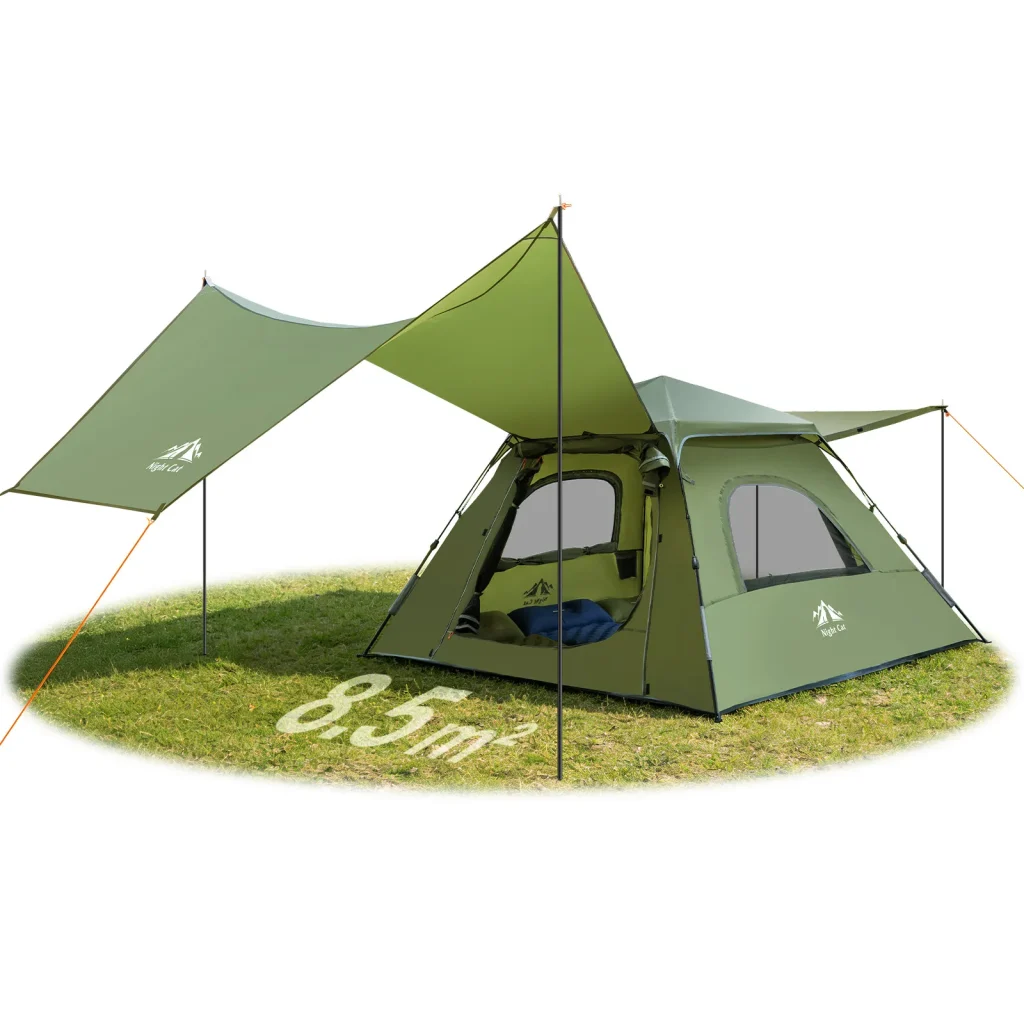
Caption: The cabin model combines a 210 × 210 cm sleeping compartment with a large detachable canopy for shade and campsite living space.
Who Should Skip Night Cat?
Consider another brand or a more technical shelter when you:
- Regularly camp in exposed wind
- Expect snow or severe winter conditions
- Hike long distances with all equipment
- Need the smallest possible packed size
- Require a tent with proven expedition performance
- Want premium aluminum poles and lighter fabrics
- Prefer an extensive retail service network
Night Cat tents are designed mainly around affordability and convenience. Problems arise when a recreational campsite tent is expected to perform like a specialized mountaineering shelter.
Final Night Cat Tent Review
Night Cat offers more than a gimmicky instant tent. Its catalog covers useful needs ranging from inexpensive dome tents to hydraulic shelters, family cabin tents, and lighter trekking-pole models.
The strongest reason to buy is value. You can get quick setup, practical sleeping space, and respectable rain protection without paying premium-brand prices.
The limitations are equally clear. The least expensive tents use ordinary materials, pop-up frames sacrifice stability for convenience, advertised capacities can be tight, and single-wall designs require careful ventilation.
Our recommendation is buy for recreational camping, but match the model to the trip.
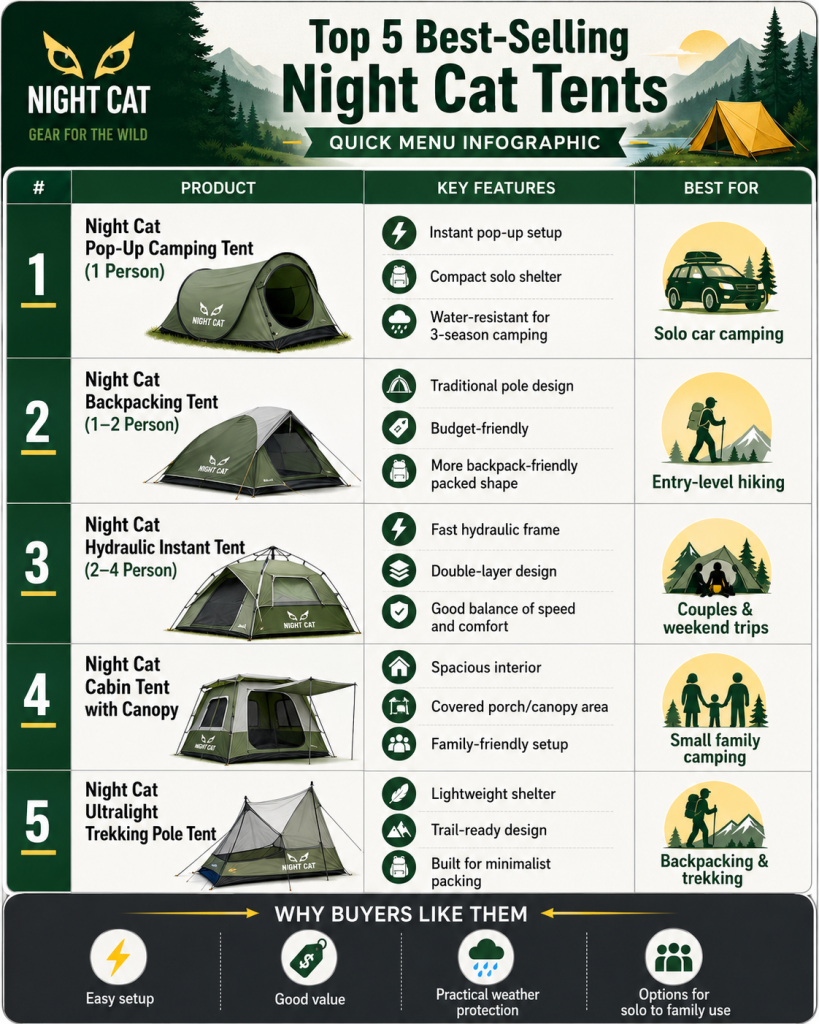
For most couples, the double-layer hydraulic instant tent provides the best balance. Solo car campers will appreciate the one-person pop-up. Hikers should avoid the circular pop-up bag and compare Night Cat’s conventional backpacking or dedicated ultralight models instead.
Overall Worthflect score: 4.0/5 — strong convenience and good value for normal three-season camping, but not designed for demanding expeditions.




Leave a Reply