
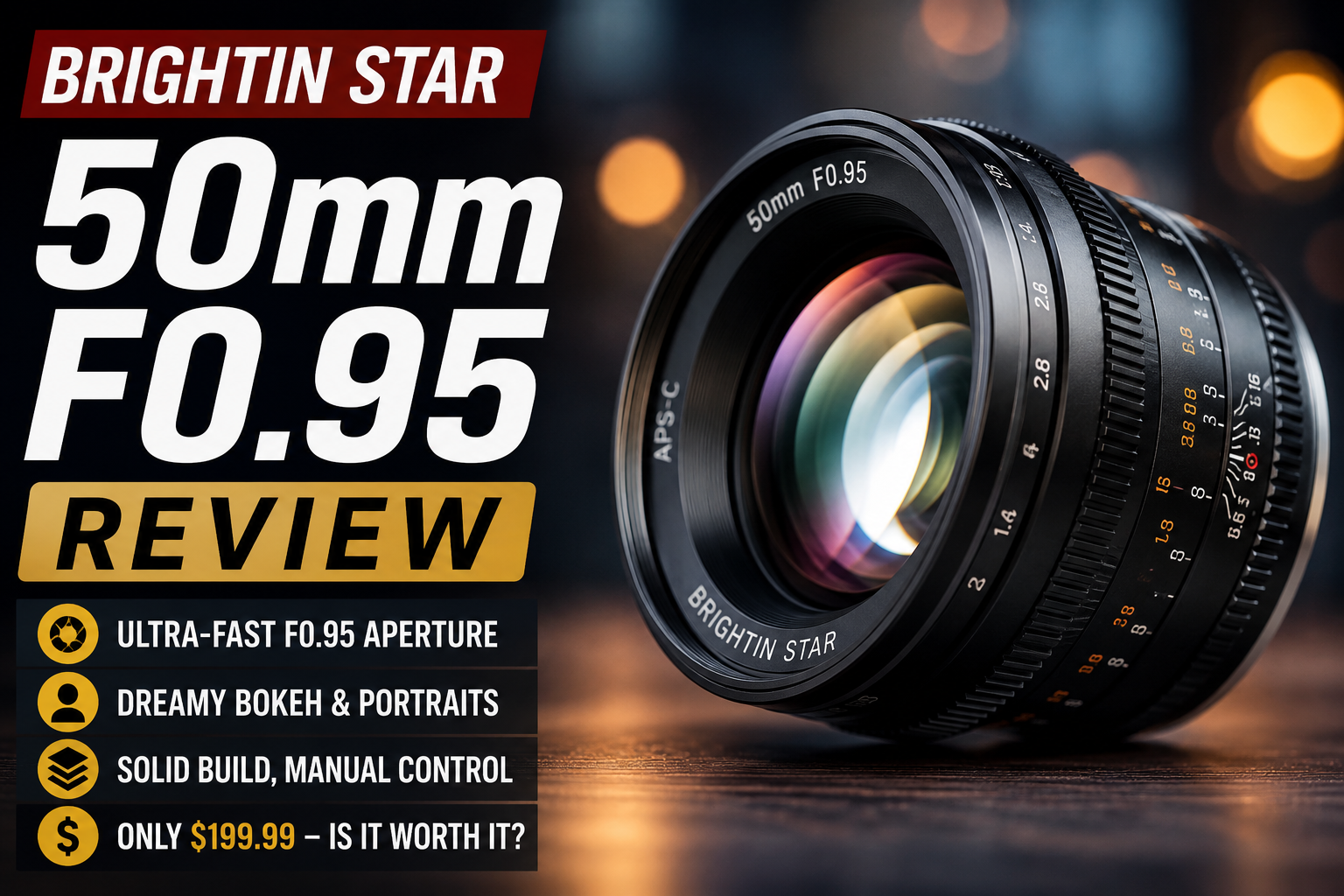
The verdict: The Brightin Star 50mm F0.95 is worth buying for photographers who deliberately want dreamy portraits, strong background separation and a slower manual-focus shooting experience. At around $199.99, it provides an unusually bright f/0.95 aperture, solid metal construction and characterful rendering without requiring a premium-lens budget.
It is not the right lens for moving children, events, sports or anyone who expects sharp, high-contrast photographs at maximum aperture. At f/0.95, the lens produces softness, vignetting, flare and chromatic aberration. Stop it down to approximately f/1.4–f/2, however, and image quality becomes considerably more dependable.
Worthflect rating: 7.9/10
Best for: controlled portraits, atmospheric night photography and creative video.
Skip it if: autofocus reliability and consistent wide-open sharpness matter more than optical character.
This Brightin Star 50mm f0 95 review focuses on the current $199.99 APS-C model. Brightin Star also sells a different full-frame 50mm F0.95 II for $409.99, so buyers should check the product name and sensor coverage carefully before ordering. (BrightinStar.US)

The Brightin Star 50mm F0.95 combines an all-metal body, manual controls and a built-in retractable hood.
What Are You Actually Buying?
The lens is an APS-C manual-focus prime available for Fujifilm X, Sony E, Nikon Z, Canon RF, Canon EOS-M and Micro Four Thirds mounts. Brightin Star offers black versions across the listed mounts and a silver option for Fujifilm X. The official price was $199.99 when checked.
On Fujifilm, Sony and Nikon APS-C cameras, the field of view is roughly equivalent to a 75mm lens on full frame. That makes it well suited to head-and-shoulder portraits, detail photographs and compressed street scenes. On Micro Four Thirds, it behaves more like a 100mm-equivalent short telephoto.
Although Canon RF, Nikon Z and Sony E versions can physically fit compatible full-frame cameras, this particular model is designed for APS-C coverage. Full-frame owners should expect to use crop mode or choose Brightin Star’s separate full-frame 50mm F0.95 II instead.
Key specifications include an f/0.95–f/16 aperture range, approximately 45cm minimum focusing distance, a 62mm filter thread and a weight of roughly 443g. The diaphragm uses 13 blades, while the focus and exposure controls are entirely mechanical.
What Shooting at F0.95 Really Feels Like
The main reason to buy this lens is not conventional sharpness. It is the visual effect created by the extremely shallow depth of field.
At close portrait distances, eyelashes may appear sharp while the ears and hair are already noticeably blurred. Background lights dissolve into large highlights, and distracting surroundings become easier to hide. This can make an ordinary location feel more cinematic.
However, f/0.95 is also demanding. A small movement from the photographer or subject can shift focus away from the eye. Even when using focus peaking, accurate focusing takes more time than autofocus. Brightin Star’s published field review recommends slowing down and focusing consciously, especially for wide-open portraits.
The lens works best when the subject can remain relatively still. It suits posed portraits, musicians, objects, evening scenes and planned video shots. For weddings, active children or spontaneous street photography, the missed-focus rate may become frustrating.
Modern mirrorless features help considerably. Focus peaking shows high-contrast edges, while magnified view allows you to inspect the subject’s eye before taking the photograph. Without those aids, achieving reliable focus at f/0.95 would be much harder.

The 443g metal lens feels substantial on a compact APS-C body, but the combination remains usable for deliberate portrait work.
Image Quality at F0.95
Wide open, the lens produces usable but technically imperfect images.
Independent reviewers consistently report lower contrast, softness, visible vignetting and some ghosting at f/0.95. Central sharpness can be acceptable at medium portrait distances, but close-up performance and image corners are substantially weaker. Strong backlight can introduce flare and further reduce contrast.
That sounds negative until you consider the intended use. Many photographers buy an f/0.95 lens specifically because they do not want clinical rendering. The slight glow around highlights and reduced contrast can give skin, nighttime scenes and artificial lights a more vintage appearance.
The key is controlling the scene. Avoid placing an intense light source directly near the edge of the frame unless flare is part of the desired result. The retractable hood helps, but it cannot eliminate every reflection created by such a large aperture.
Chromatic aberration can appear around high-contrast details, particularly dark hair against bright sky or reflective objects. Correcting purple and green fringing in RAW software is often necessary.
In practical terms, use f/0.95 for mood and subject isolation not because it is the lens’s sharpest setting.
Performance at F1.4 and F2
Image quality improves meaningfully after stopping down.
At approximately f/1.4, central resolution becomes more convincing while the background remains heavily blurred. By f/2, several reviewers found the lens substantially sharper, with better contrast and fewer visible wide-open defects. One Fujifilm reviewer described f/2 performance as impressive even on a 40-megapixel camera, while another regarded f/2 as the lens’s most satisfying setting.
This makes f/1.4–f/2 the practical operating range for many portraits. You retain much of the lens’s signature separation while improving the chance of getting both eyes acceptably sharp.
For general photography, stopping down further gives more predictable results. The lens can produce good photographs at conventional apertures, but buyers should remember that its main value is the ability to access the unusual f/0.95 look when required.
Bokeh and Portrait Rendering
The 13-blade aperture helps maintain rounded highlights as the lens is stopped down. Background blur is generally smooth, especially at close and medium focusing distances. The transition between focused and unfocused areas can create a strong three-dimensional impression.
Bokeh is not perfectly neutral. Toward the frame edges, highlights can become compressed into cat-eye shapes because of optical vignetting. Some photographers will consider this distracting; others will see it as part of the lens’s character.
The 50mm focal length on APS-C also helps portrait composition. You can maintain a comfortable working distance without creating the exaggerated facial perspective associated with shooting too close using a wider lens.
For full-body portraits indoors, the effective short-telephoto field of view may feel restrictive. Check that your normal locations provide enough distance between the camera and subject.

Caption: Sample images demonstrate the lens’s emphasis on soft backgrounds and atmospheric rendering rather than clinical wide-open sharpness.
Build Quality and Handling
The physical construction is one of the lens’s strongest features.
Brightin Star uses an all-metal barrel and metal mount, giving the lens a much more substantial feel than its price might suggest. Reviewers generally describe the focus ring as smooth and well damped, while the clicked aperture ring provides clear physical feedback.
The retractable metal hood is convenient because it cannot be forgotten at home. It also preserves the lens’s retro appearance. However, it offers less protection than a larger removable hood and does not fully solve flare problems.
At approximately 443g, the lens is not exceptionally heavy in isolation, but it can make compact cameras feel front-heavy. Adding a grip may improve balance during longer sessions.
There are no electronic contacts. The camera generally will not record aperture information in the EXIF data, and users may need to enable a setting such as “release without lens” before taking photographs. Brightin Star’s FAQ specifically addresses this requirement for its manual lenses.
Is It Good for Video?
The Brightin Star 50mm F0.95 can produce attractive cinematic footage, especially for controlled close-ups and low-light scenes.
The mechanical focus ring allows repeatable focus pulls, and the wide aperture helps isolate faces or objects. One technical review also reported relatively limited focus breathing, which is useful when transitioning between subjects.
The clicked aperture ring is less video-friendly than a fully stepless design because changing exposure during recording may create visible jumps and audible clicks. Handheld focus tracking is also challenging at f/0.95.
It is therefore better for planned shots, interviews, music videos and short creative sequences than fast documentary filming.
Price, Shipping and Returns
At $199.99, the lens offers good value when judged as a specialist creative tool. It offers metal construction, an extremely bright aperture and multiple mirrorless-mount options at a price below many autofocus portrait lenses.
Brightin Star advertises free shipping on orders above $55, a two-year limited warranty and a 90-day return policy. Its delivery page says orders typically require two to five business days for preparation, followed by approximately four to twenty working days for international delivery.
The return terms deserve attention. Quality problems and incorrect products receive broader coverage, while selecting the wrong mount can make the customer responsible for postage and a substantial return fee. Returns based purely on changing your mind may not be covered. Verify your exact camera mount before ordering.
Pros and Cons
What I Like
- Extremely shallow depth of field at f/0.95
- Smooth, characterful portrait rendering
- Strong metal construction
- Useful built-in lens hood
- 13-blade aperture
- Multiple mirrorless-mount options
- Much sharper when stopped down to f/1.4–f/2
- Competitive $199.99 official price
What Could Be Better
- Manual focusing is difficult with moving subjects
- Softness and lower contrast at f/0.95
- Noticeable flare, ghosting and chromatic aberration
- Weak corners, particularly at close distances
- No electronic contacts or EXIF aperture data
- Heavy for some compact APS-C bodies
- Clicked aperture is not ideal for exposure changes during video
Final Verdict: Is the Brightin Star 50mm F0.95 Worth It?
Yes, provided you want an artistic manual lens rather than an everyday portrait workhorse.
The Brightin Star 50mm F0.95 delivers its strongest results when the photographer accepts its imperfections and uses them intentionally. Wide open, it creates dreamy backgrounds, soft highlights and dramatic subject separation. At f/2, it becomes substantially sharper and more versatile.
Its limitations are equally clear. Autofocus alternatives are more dependable for events, families and commercial portraits. Some independent reviewers found those alternatives easier to recommend when image consistency matters more than f/0.95 rendering.
Buy the Brightin Star when you enjoy manual focusing, regularly photograph still subjects and want a distinctive low-light or portrait look. Skip it when every frame must be technically clean and immediately in focus.
For patient photographers, it is not merely a cheap fast lens. It is an affordable creative tool with enough character to make familiar locations and simple portraits look noticeably different.



Leave a Reply