

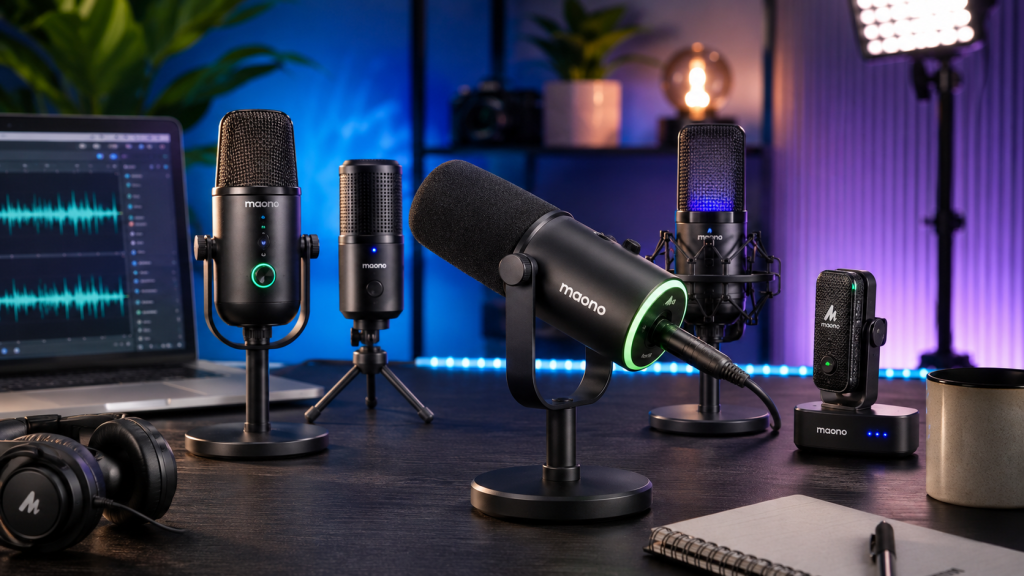
Maono Microphone Review: Are Maono Mics Actually Good?
Maono microphones have become popular among podcasters, gamers, streamers, YouTubers, and beginner voice-over creators because they offer many of the features found on more expensive microphones at a lower price.
But are Maono microphones genuinely good, or are they simply cheap microphones with impressive specifications?
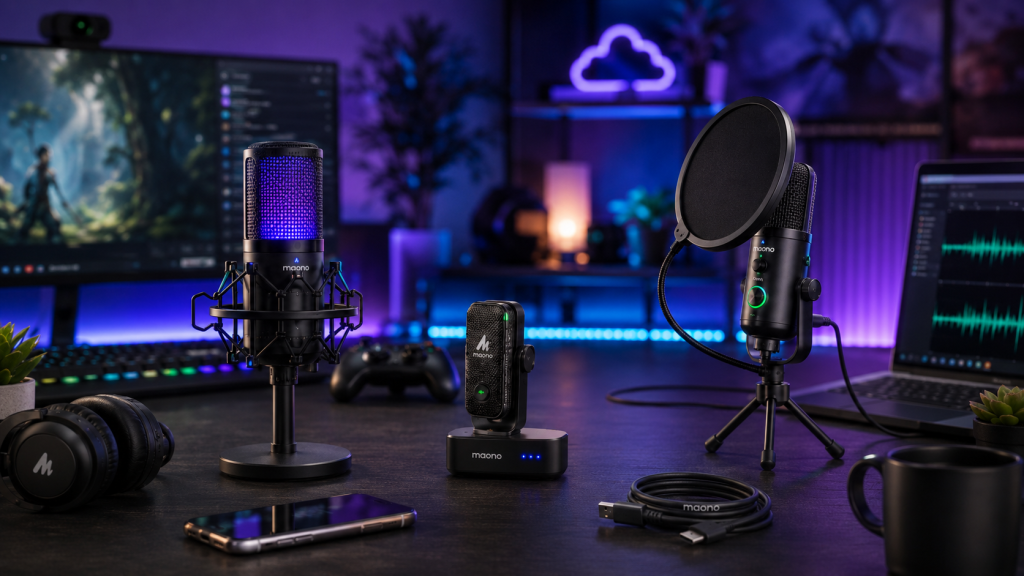
In this Maono microphone review, we compare the brand’s most popular models, including the PD200X, PD200W, PD400X, DM40, and A04. We will examine the areas buyers care about most: sound quality, background-noise rejection, build quality, connectivity, software, ease of use, and overall value.
Quick Verdict
Maono microphones are worth considering if you want good voice quality, practical controls, and flexible connectivity without paying premium-brand prices.
The Maono PD200X is the best choice for most buyers because it combines a dynamic capsule, USB and XLR connections, headphone monitoring, onboard controls, and Maono Link software at a reasonable price.
The PD200W is better for creators who need wireless, USB, and XLR recording in one microphone. The PD400X is a more refined podcasting option, while the DM40 is designed mainly for gamers and casual streamers who prefer wireless convenience and RGB lighting.
However, Maono microphones are not perfect. Some models require careful positioning, the software does not support every Maono microphone, and the sound may need EQ or compression before it feels fully polished.
Best Maono Microphones Compared
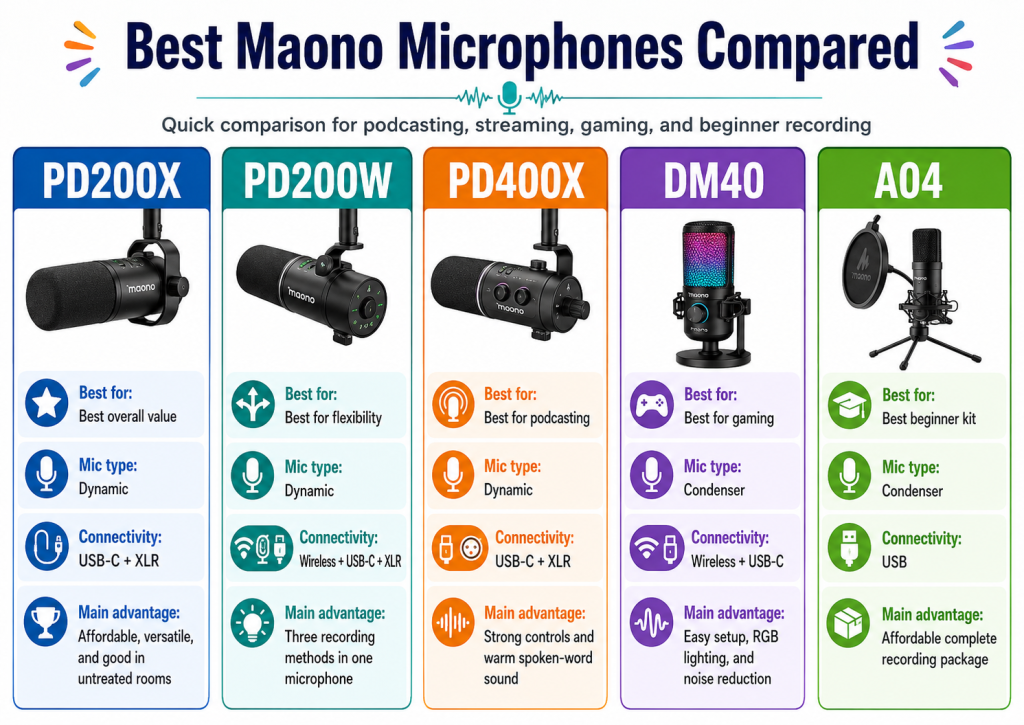
Prices vary by promotion and bundle, but Maono currently positions these models from budget beginner products to more advanced podcasting microphones. Its official microphone collection includes USB, XLR, hybrid, condenser, dynamic, and wireless options.
Is Maono a Good Microphone Brand?
Maono is a good value-focused microphone brand, particularly for people moving away from laptop, headset, or webcam microphones.
Its strongest advantage is not that every Maono microphone sounds better than every competitor. The main advantage is the amount of functionality included for the price.
Depending on the model, you may get:
- USB plug-and-play recording
- XLR connectivity for future upgrades
- Wireless operation
- Headphone monitoring
- Physical gain controls
- One-touch mute
- Built-in noise reduction
- Custom EQ and compression
- RGB lighting
- Smartphone, computer and console compatibility
Maono’s current microphone range is designed for podcasting, gaming, streaming, content creation, online meetings, and mobile recording. The official store lists both condenser and dynamic microphones, with prices ranging from entry-level products to larger microphone and audio bundles.
Maono Microphone Sound Quality
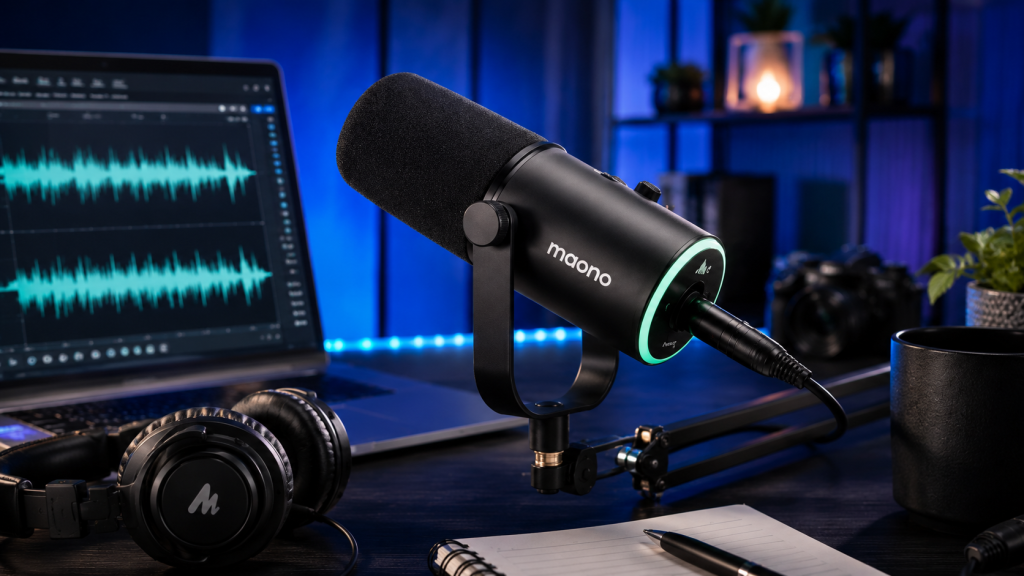
Maono’s sound quality depends heavily on the model you choose.
Dynamic Maono Microphones
Dynamic models such as the PD200X, PD200W, and PD400X are generally the better choices for podcasting, streaming, voice-over work, and recording in untreated rooms.
They are less sensitive than condenser microphones and normally pick up less keyboard noise, fan noise, room echo, and sound coming from behind the microphone. However, you must speak close to the front of the capsule.
For example, Maono recommends keeping the PD200X within approximately 15 centimeters of your mouth. Speaking too far away can make the recording sound quiet, thin, or distant.
Condenser Maono Microphones
Condenser models such as the A04 and DM40 can capture a brighter and more detailed sound. They work well for online meetings, casual vocals, gaming, and beginner content creation.
The disadvantage is that condenser microphones are usually more sensitive to room reflections and background noise. In a noisy bedroom or office, a dynamic model will normally be easier to control.
Maono PD200X Review: Best Overall Value
The Maono PD200X is the model most buyers should consider first.
It is a dynamic cardioid microphone with both USB-C and XLR connectivity. In USB mode, it can connect directly to a computer for plug-and-play recording. In XLR mode, it can connect to an audio interface or mixer when you are ready to build a more advanced setup.
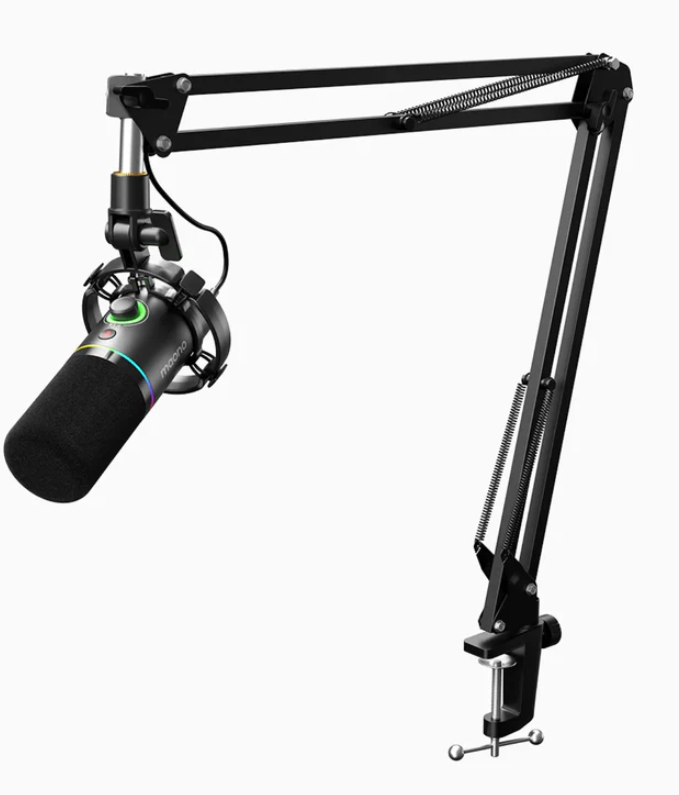
Official specifications include:
- Dynamic capsule
- Cardioid pickup pattern
- 40Hz–16kHz frequency response
- 24-bit/48kHz digital recording
- Maximum sound pressure level above 130dB
- USB-C and XLR outputs
- Headphone monitoring
- Gain and headphone-volume control
- One-click mute
- Maono Link software support
How Does the PD200X Sound?
The PD200X produces a focused, full voice sound when used close to the mouth. Its dynamic capsule and cardioid pattern help reduce sound arriving from the sides and rear.
It is particularly suitable for:
- Solo podcasts
- YouTube narration
- Gaming streams
- Online teaching
- Voice-over practice
- Discord and video calls
Independent reviewers have generally described the PD200X as a strong entry-level microphone rather than a replacement for professional studio equipment. The Audiobook Guy rated it four out of five and praised its value for newcomers to voice-over and audiobook recording.
PD200X Pros
- Excellent feature-to-price ratio
- USB and XLR connectivity
- Better room-noise rejection than most cheap condenser microphones
- Useful onboard gain and mute controls
- Solid metal construction
- Maono Link EQ and processing options
- Easy upgrade path to an audio interface
PD200X Cons
- Must be positioned close to your mouth
- XLR mode requires an audio interface or mixer
- RGB may be unnecessary for business users
- Software features are mainly available in USB mode
- A boom arm may provide a better experience than the basic desktop setup
Who Should Buy the PD200X?
Choose the PD200X when you want an affordable podcasting or streaming microphone that works immediately through USB but can also grow with a future XLR setup.
Maono PD200W Review: Best for Wireless Flexibility
The Maono PD200W is one of the most unusual microphones in Maono’s lineup because it supports three connection methods:
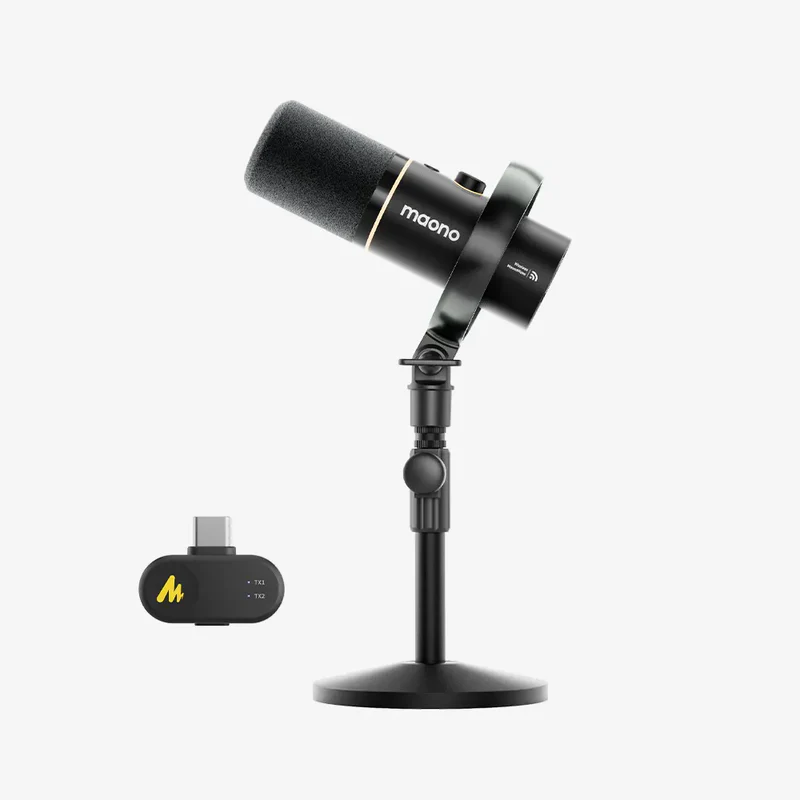
- USB-C
- XLR
- 2.4GHz wireless
This makes it useful for creators who record at a desk but occasionally need to move the microphone, connect it to a camera, or simplify a temporary podcasting setup.
The PD200W uses a 30mm dynamic capsule with a cardioid pickup pattern and records at up to 24-bit/48kHz. It also includes three levels of noise reduction, a 3.5mm monitoring output, and a claimed wireless range of up to 60 meters under line-of-sight conditions. Maono rates its battery for approximately 38 hours with RGB enabled or 60 hours with RGB disabled.
How Does the PD200W Sound?
Independent testing by GamesRadar found that the PD200W produced clean, rich audio with good detail and warmth for its price. The review also found that performance remained reasonably consistent across USB, XLR, and wireless modes, although minor post-processing could improve the final result.
The dynamic capsule does a good job of rejecting unwanted room noise when you speak directly into the front. However, your voice can lose clarity quickly when you move away from the correct recording position.
PD200W Pros
- Wireless, USB and XLR recording
- Good spoken-word sound
- Long claimed battery life
- Useful onboard noise reduction
- Headphone monitoring
- Works with multiple recording setups
- Strong value compared with premium hybrid microphones
PD200W Cons
- More expensive than the PD200X
- Wireless receiver can take up considerable space
- Mute button may create handling noise
- Some controls feel less premium than the microphone body
- Wireless connectivity may be unnecessary for desk-only users
Who Should Buy the PD200W?
The PD200W is ideal for podcasters, interviewers, YouTubers, streamers, and mobile creators who genuinely need more than one connection method.
For creators who only record at a computer, the less expensive PD200X may offer better value.
Maono PD400X Review: Best for Dedicated Podcasting
The Maono PD400X is positioned above the PD200X as a more refined podcasting microphone.
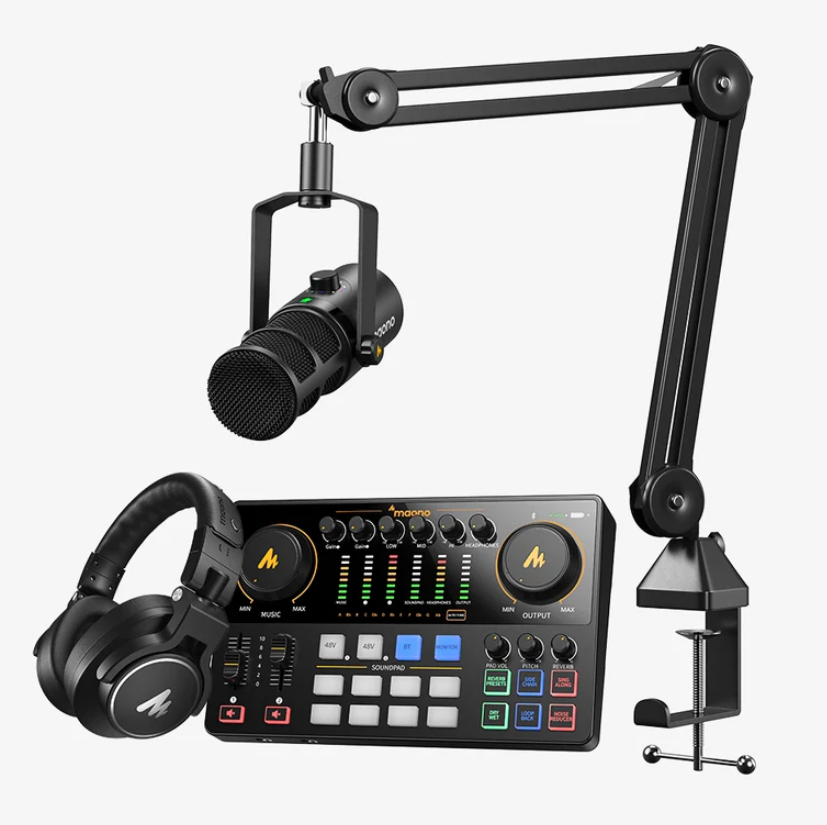
It is a dynamic cardioid microphone with USB-C and XLR outputs, a 40Hz–16kHz frequency response, 24-bit/48kHz recording, and a maximum sound pressure level above 130dB. Its controls allow you to adjust microphone gain, headphone volume, and monitoring mix directly from the microphone.
The PD400X is designed to produce a warm, forward voice sound suitable for podcasts, narration, interviews, and live streaming.
PD400X Pros
- Warm podcast-style voice reproduction
- USB and XLR connectivity
- Strong physical controls
- Headphone monitoring and monitor-mix adjustment
- One-touch mute
- Durable design
- Maono Link software support
PD400X Cons
- Costs considerably more than the PD200X
- Sound improvement may not justify the price for beginners
- Still requires close microphone positioning
- Faces strong competition from established podcasting microphones
Independent opinions on the PD400X are mixed. Some reviewers praise its warm, clear sound and straightforward USB setup, while others consider it only an average value when compared with established alternatives such as the Shure MV7, Rode PodMic, or Shure SM58.
Who Should Buy the PD400X?
Choose the PD400X when you want a dedicated spoken-word microphone with more refined onboard controls and are willing to pay more than the cost of the PD200X.
Maono DM40 Review: Best for Gaming and Wireless Desks
The Maono DM40 is a wireless and USB condenser microphone designed mainly for gaming, streaming, and visually attractive desktop setups.
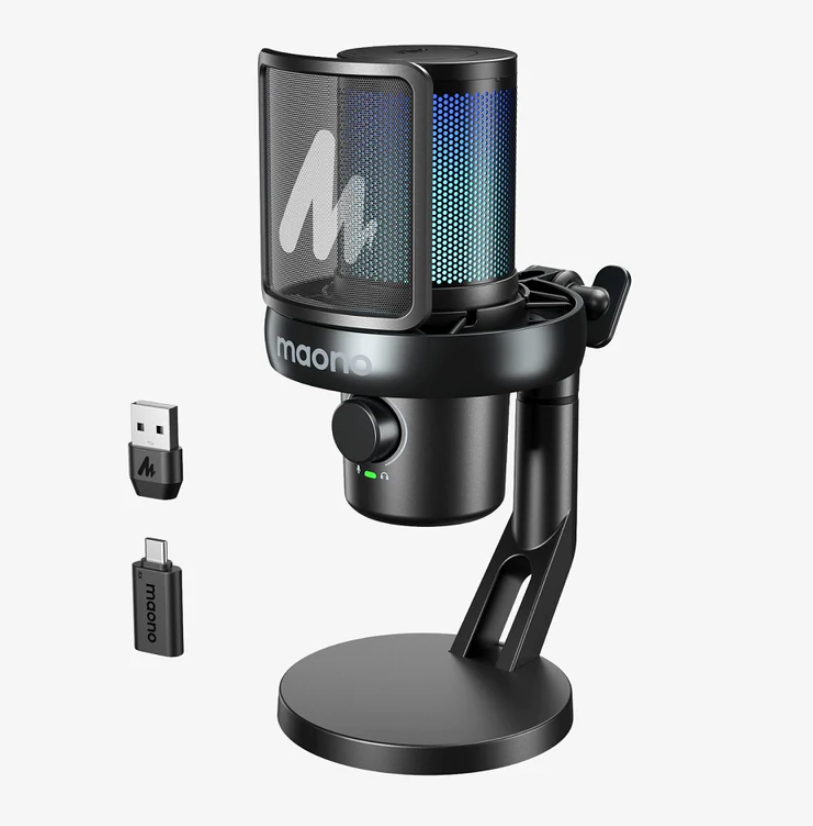
It supports wireless, USB, and USB-C connections and works with computers, tablets, smartphones, voice recorders, and supported PlayStation consoles. It also includes RGB lighting, headphone monitoring, a gain control, mute control, and Maono Link customization.
How Does the DM40 Sound?
The DM40 provides clear enough audio for gaming, Discord, casual streaming, and online communication. Its unidirectional pickup and noise-reduction processing can help control keyboard and room noise.
However, it is still a condenser microphone. It may not produce the same focused, warm spoken-word tone as the PD200X, PD200W, or PD400X.
Tom’s Guide rated the DM40 Pro 3.5 out of five. The reviewer praised its ambient-noise reduction, controls, RGB design, and beginner-friendly setup but found that the voice lacked some of the warmth and depth expected for professional podcasting or streaming.
DM40 Pros
- USB and wireless convenience
- Easy controls
- Attractive RGB lighting
- Effective ambient-noise minimization
- Beginner-friendly setup
- Useful Maono Link features
DM40 Cons
- Voice can sound thinner than a good dynamic microphone
- Condenser capsule may capture room reflections
- RGB and voice effects may not matter to serious creators
- Not the best choice for professional voice-over work
Who Should Buy the DM40?
The DM40 makes the most sense for gamers and casual streamers who prioritize wireless convenience, visual design, and easy controls over a traditional broadcast-style sound.
Maono A04 Review: Best Low-Cost Beginner Kit
The Maono A04 is one of the brand’s older and most recognizable USB condenser microphone kits.
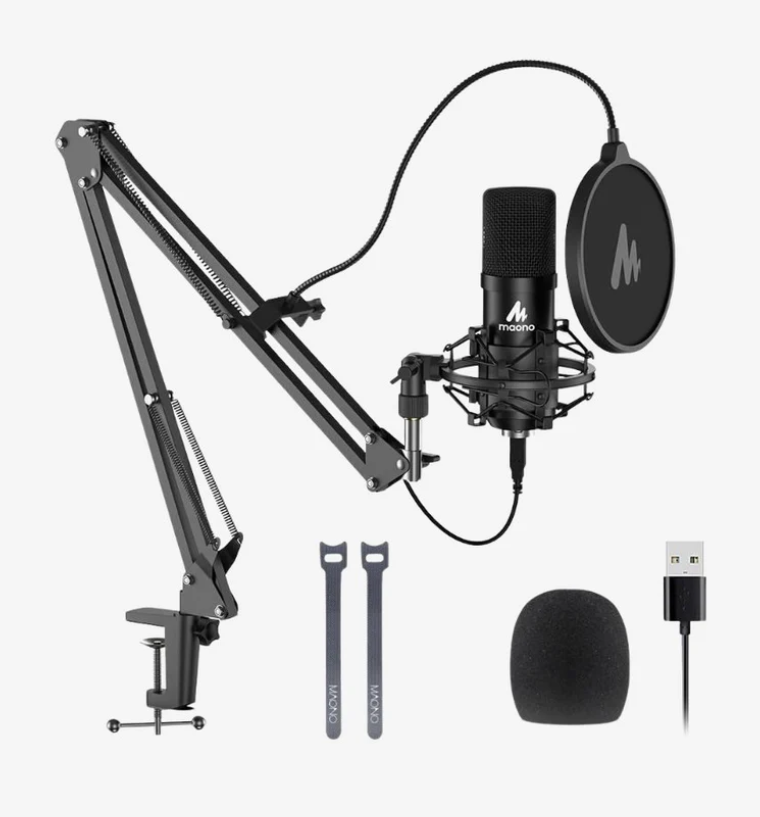
It is designed for beginners who want a complete package without purchasing an audio interface, stand, shock mount, and pop filter separately.
The official kit includes a USB microphone and recording accessories, and it remains one of Maono’s more affordable options. Maono currently lists the A04 at around $60 before promotional changes.
A04 Pros
- Very affordable
- Simple USB connection
- Complete beginner package
- Clear, bright voice capture
- Suitable for meetings, beginner YouTube videos and casual recording
- No audio interface required
A04 Cons
- More sensitive to background noise and echo
- Limited onboard controls
- Less flexible than USB/XLR models
- Older design
- Not ideal for untreated or noisy rooms
The A04 is still a practical first microphone, but buyers who can increase their budget should consider the PD200X. Its dynamic capsule and XLR upgrade option make it a more flexible long-term purchase.
Maono Link Software: Is It Useful?
Maono Link is one of the brand’s strongest features.
Depending on the connected microphone, the software can provide:
- Microphone gain adjustment
- Headphone-volume control
- Equalization
- Noise suppression
- Compression
- Limiting
- Audio monitoring
- Firmware updates
- RGB customization
Maono currently lists support for models including the PD100W, PD200W, DM30, DM40, PD100X, PD200X, PD300X, and PD400X. Not every Maono microphone is supported, so compatibility should be checked before purchasing.
The software can improve an already clean recording, but it cannot completely repair poor microphone placement, excessive room echo, clipping, or heavy background noise.
Common Maono Microphone Problems
The Microphone Sounds Too Quiet
Dynamic microphones need to be placed close to your mouth. Start approximately four to six inches away and speak toward the front of the capsule.
Increase the microphone gain gradually rather than immediately setting it to maximum.
The Microphone Picks Up Keyboard Noise
Move the microphone closer to your mouth and reduce the gain. Position the keyboard behind or below the microphone’s main pickup direction.
A dynamic model such as the PD200X will usually reject keyboard noise more effectively than a sensitive condenser microphone.
There Is a Humming or Electrical Noise
Connect the microphone directly to the computer instead of using an unpowered USB hub. Try another USB port or cable and keep the microphone cable away from power supplies and other electronic equipment.
Maono also recommends testing the microphone with the computer’s basic recording software to determine whether the noise is caused by third-party applications.
Maono Link Does Not Detect the Microphone
Confirm that your model supports Maono Link, connect it directly to the computer, and install the latest software version. Maono recommends avoiding hubs and docking stations during troubleshooting.
Which Maono Microphone Should You Buy?
Choose the PD200X when you want the best balance of price, sound quality, background-noise rejection, and future upgrade options.
Choose the PD200W when wireless recording is genuinely useful and you want wireless, USB, and XLR connections in one microphone.
Choose the PD400X when podcasting is your main priority and you want stronger onboard monitoring controls.
Choose the DM40 when you want a wireless gaming microphone with RGB lighting and easy software customization.
Choose the A04 when your budget is very limited and you want a complete beginner USB microphone kit.
Are Maono Microphones Good for Podcasting?
Yes. The PD200X, PD200W, and PD400X are all suitable for solo podcasting.
Dynamic Maono microphones are particularly useful for home podcasters because they capture less room sound than highly sensitive condenser microphones. For the best result, use a boom arm, speak close to the microphone, keep the gain under control, and record in a room with curtains, carpets, or other soft materials.
For a two-person podcast, each speaker should normally have a separate microphone rather than sharing one microphone placed in the center of a table.
Are Maono Microphones Good for Gaming?
Yes. The PD200X is a strong option for gamers who want focused voice capture, while the DM40 is better for users who want wireless operation and RGB lighting.
For gaming in a room with a mechanical keyboard, cooling fans, or other people, a dynamic microphone is usually the safer choice.
Are Maono Microphones Good for Singing?
Maono condenser microphones can work for beginner vocal recording, demos, and social-media content. Dynamic models can also record vocals, especially in untreated rooms.
However, serious singers should compare Maono models with established studio microphones and consider room treatment, an audio interface, microphone technique, and post-production software as part of the total recording setup.
Final Verdict: Is a Maono Microphone Worth It?
Maono microphones offer strong value for beginners and intermediate creators.
They are especially appealing to users who want USB simplicity, practical physical controls, software customization, and the option to move into XLR recording later.
The Maono PD200X is the best overall recommendation. It is affordable, versatile, easier to use in a normal home environment, and suitable for podcasting, gaming, streaming, meetings, and YouTube narration.
The PD200W is the better choice when wireless connectivity matters, while the PD400X is suitable for buyers who want a more dedicated podcasting microphone.
Maono may not replace premium studio brands for professional recording, but the company provides several capable microphones that deliver much better results than built-in laptop, webcam, and gaming-headset microphones without requiring a large investment.
Frequently Asked Questions
Is Maono better than Blue Yeti?
A dynamic Maono microphone such as the PD200X may be easier to use than the Blue Yeti in a noisy or untreated room. The Blue Yeti offers multiple pickup patterns, but its sensitive condenser capsule can capture more keyboard noise and room echo.
Is Maono better than Fifine?
Both brands offer strong budget microphones. Maono is particularly competitive in software integration and hybrid connectivity, while Fifine offers many affordable gaming-focused options. The better choice depends on the specific models rather than the brand name alone.
Does a Maono microphone need an audio interface?
USB Maono microphones do not need an audio interface. An interface is only required when using the microphone’s XLR output.
Can Maono microphones work with a phone?
Several Maono models support smartphones through USB-C or compatible adapters. Compatibility varies by model and phone connection, so buyers should check the package contents before ordering.
What is the best Maono microphone for beginners?
The PD200X is the best beginner microphone for buyers who can afford it. The A04 is a less expensive alternative for users who want a complete USB condenser microphone kit.
What is the best Maono microphone for a noisy room?
A close-positioned dynamic microphone such as the PD200X, PD200W, or PD400X is normally the best option. Avoid placing the microphone far away and using excessive gain.


Leave a Reply