


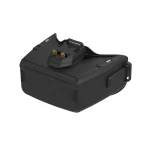
Caption: The SKY04X prioritizes a larger, sharper viewing experience, while the SKY04O delivers most of the same core features in a more affordable package.
Quick Verdict: SKY04X or SKY04O?
The Skyzone SKY04X is the better overall goggle, but the SKY04O can be the smarter purchase when it is significantly cheaper.
Both models use OLED panels, support adjustable focus, include a 5.8GHz receiver, record DVR footage and accept HDMI input. The biggest difference is what you see inside the goggles: the SKY04X has a 1280 × 960 display and a 46-degree field of view, while the SKY04O uses a 1024 × 768 display with a smaller 38-degree field of view.
That difference is noticeable. The SKY04X produces a larger, more immersive image and makes small branches, gates and OSD text easier to examine. The SKY04O feels less dramatic, but its smaller image is easier to view from edge to edge without moving your eyes as much.
The practical buying rule is simple:
- Choose the SKY04X when the price difference is under approximately $75–$100.
- Choose the SKY04O when it is at least $100 cheaper and you mainly fly traditional analog FPV.
- Skip both at full historical retail pricing unless you specifically want an older premium analog headset.
This comparison covers the original SKY04X V2 and SKY04O, not the newer SKY04X Pro or SKY04O Pro. At the time of checking, SKYZONE listed the original SKY04X V2 at $529 and the SKY04O at $429, but both original versions were sold out on the official store. Buyers are therefore most likely to encounter them as used, refurbished or remaining dealer stock.
Worthflect ratings
| Category | SKY04X | SKY04O |
|---|---|---|
| Analog image quality | 9.0/10 | 8.3/10 |
| Immersion | 9.0/10 | 7.8/10 |
| Edge-to-edge visibility | 8.1/10 | 8.8/10 |
| Receiver and DVR | 8.6/10 | 8.5/10 |
| Comfort and adjustment | 8.7/10 | 8.7/10 |
| Value when discounted | 8.8/10 | 8.9/10 |
| Overall | 8.7/10 | 8.4/10 |
Overall winner: SKY04X
Best-value winner: SKY04O, when substantially cheaper
SKY04X vs SKY04O Specifications
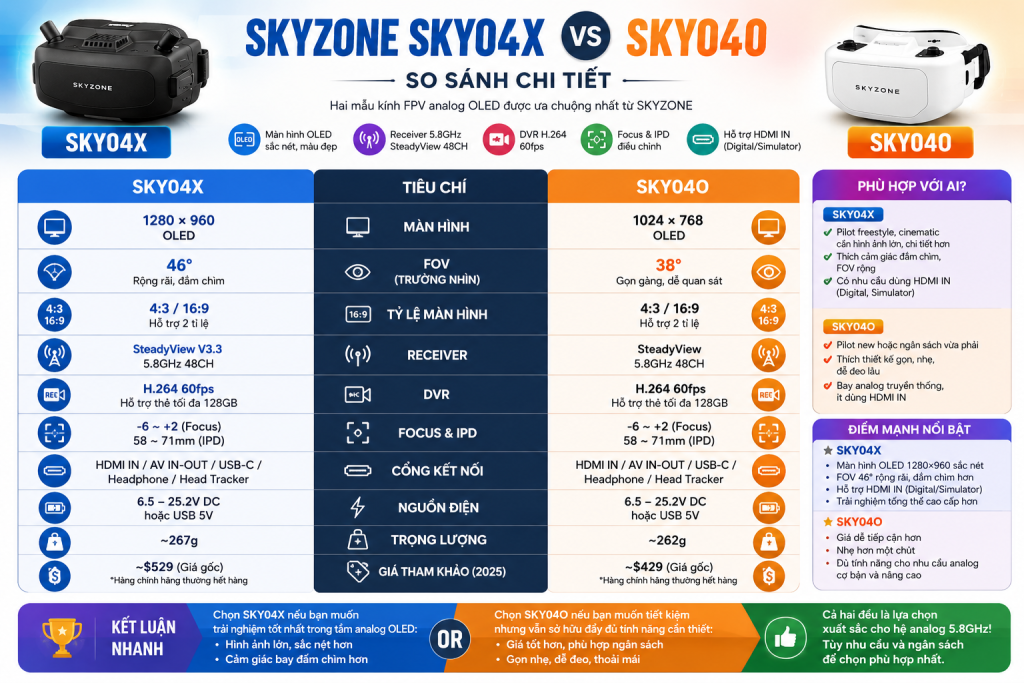
The two goggles share far more than their names suggest. Their housings, controls, power options, optical adjustment ranges and accessory packages are extremely similar. The SKY04X premium is primarily paying for its higher-resolution panels and larger optics rather than a completely different goggle platform.
Display Experience: The SKY04X Wins Clearly
The display is the strongest reason to choose the SKY04X.
Its 1280 × 960 OLED panels deliver more display resolution than the SKY04O’s 1024 × 768 panels. Both retain OLED’s main strengths: deep blacks, vivid colors and strong contrast, which are especially helpful when flying between bright sky and shadowed ground or through indoor environments with uneven lighting.
Do not expect either model to turn a basic analog camera into high-definition video. The camera, video transmitter and analog link still limit the amount of detail reaching the goggles. The higher-resolution SKY04X panel presents that signal more cleanly, but it cannot recreate information that was never transmitted.
The difference is still visible in daily use. Fine OSD text looks cleaner on the SKY04X, and the larger image makes it easier to identify narrow gaps or obstacles during freestyle. Its additional resolution is also useful when viewing an external video source through HDMI.
Independent testing described the SKY04X image as sharp and clear, with image quality comparable to other flagship analog goggles of its generation. The same review highlighted the combination of a 1280 × 960 display and 46-degree FOV as one of its main strengths. (Oscar Liang)
Does the SKY04O still look good?
Yes. The SKY04O is not a budget LCD headset. Its 1024 × 768 OLED display still provides stronger blacks and richer colors than many inexpensive box goggles.
For pilots flying tiny whoops, casual backyard sessions or conventional 4:3 analog cameras, its resolution is adequate. The image is smaller, but it does not feel cramped in the way some older compact goggles do.
The SKY04O therefore loses the specification contest without becoming a poor viewing experience. Its display is best described as practical and comfortable rather than highly immersive.
Field of View: Bigger Is Not Always Better
The SKY04X has a 46-degree diagonal FOV, compared with 38 degrees on the SKY04O.
A larger FOV means the SKY04X image occupies more of your vision. This creates the sensation of being inside the aircraft rather than watching the flight on a small floating screen. Freestyle pilots and people flying scenic fixed-wing routes are likely to appreciate that extra immersion.
However, a large image also requires more eye movement. Depending on your face shape, IPD and optical adjustment, the corners may appear less sharp than the center. OSD elements positioned at the extreme edges can also take slightly more effort to monitor.
The SKY04O’s 38-degree view is less exciting but easier to absorb as one complete frame. Racers who constantly check lap timers, voltage and warning information may prefer this more compact presentation. It can also feel less tiring during long sessions because the pilot does not need to scan across such a wide virtual screen.
Choose SKY04X for immersion. Choose SKY04O for effortless edge-to-edge visibility.
Receiver Performance: Almost No Reason to Pay More

Caption: The SKY04O retains the familiar SKYZONE interface, adjustable optics and modular receiver design despite its lower-resolution display.
Credit: SKYZONE official
The receiver is not the main reason to upgrade from the SKY04O to the SKY04X.
The SKY04X V2 officially includes the V3.3 SteadyView receiver, while the SKY04O is also marketed as a SteadyView-equipped 48-channel analog package. SteadyView uses the two antenna inputs to improve image stability and reduce tearing or rolling when reception conditions change.
Independent testing found the SKY04X’s included SteadyView module competitive enough that most pilots would not need to immediately replace it with RapidFire or TBS Fusion. The goggles also accept aftermarket receiver modules, although some third-party modules require a different or 3D-printed bay cover.
In real use, antenna choice will probably matter more than the difference between these two goggles. The included linear antennas are suitable for initial testing, but a circularly polarized omnidirectional antenna paired with a patch antenna will normally provide a more useful combination of coverage and forward range.
Because both models use a similar receiver system, reception quality should not be the deciding factor. Select between them based on the screens, FOV and price.
Comfort, Fit and Optical Adjustment
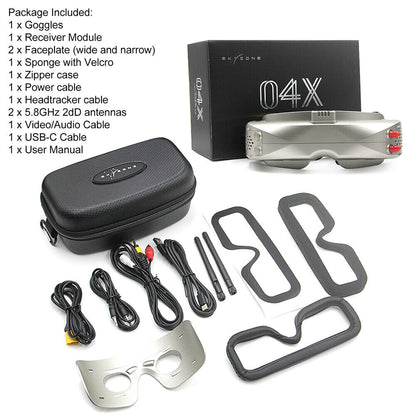
Caption: SKYZONE supplies the SKY04X with two faceplates, replaceable padding, a receiver module, cables, antennas and a protective case.
Image source: SKYZONE official
Comfort is essentially a tie.
Both models use a 185 × 75 × 67mm housing, and the official weight difference is only five grams: 267g for the SKY04X and 262g for the SKY04O. Both packages include wide and narrow faceplates, removable foam, a carrying case and the main cables needed for operation.
Including two faceplates is more important than it may appear. Goggle comfort depends heavily on nose shape, cheekbones and forehead contact. Changing the faceplate can reduce light leakage and distribute pressure more evenly.
An independent SKY04X review praised the wide head strap and found it secure and comfortable. The reviewer also considered the two faceplate options a meaningful advantage because they allow a better fit for different facial profiles.
Both goggles provide independent focus adjustment from approximately -6 to +2 and an IPD range of 58–71mm. Many nearsighted pilots can therefore fly without wearing glasses or installing separate diopter inserts.
To obtain the sharpest image, adjust one eye at a time while viewing menu text or a clear OSD. After both sides are focused, adjust the IPD until the two images merge comfortably.
Controls and Everyday Usability
The SKY04X and SKY04O use SKYZONE’s shuttle-wheel interface rather than relying entirely on small multifunction buttons. Pilots can navigate channels, bands, display settings and DVR options while still wearing the headset. Both models also provide four preset image modes and three custom profiles.
The SKY04X independent review found the roller controls easier to use than conventional push-button interfaces. Available adjustments include brightness, contrast, saturation, hue, sharpness, fan speed and DVR settings.
Both models support DC power from 6.5V to 25.2V and 5V USB power. That means pilots can use a 2S–6S battery or, in suitable conditions, a USB power bank. A long power cable also allows the battery to remain in a pocket instead of being attached to the head strap.
Daily usability is therefore nearly identical. Buying the SKY04X does not give you a dramatically better menu or more convenient controls.
DVR Recording
Both models officially support H.264 recording at up to 60fps, MOV files at approximately 6Mbps and microSD cards up to 128GB.
DVR footage is valuable for locating a crashed quad, reviewing racing lines and diagnosing signal breakup. It records the incoming FPV feed, so analog static, OSD data and interference remain visible. It is not intended to replace an onboard action camera.
Early SKY04X units originally recorded at 30fps, but SKYZONE later provided a firmware upgrade enabling 60fps recording. Anyone buying an older used unit should verify its firmware and test the DVR before relying on it.
The official download page continues to list firmware files for the SKY04X, SKY04O and SteadyView receivers, so checking the hardware version before updating is important.
HDMI and Digital Upgrade Potential
Both goggles include HDMI input, allowing them to display video from a compatible external receiver or a computer running an FPV simulator. The SKY04O official media specifically lists HDMI among its accessible ports, while the SKY04X has HDMI, AV input/output, USB-C, headphone and head-tracker connections.
The SKY04X is the better choice for external digital use because its 1280 × 960 panels provide more display resolution. Even so, neither model offers the clean integration of native Walksnail, HDZero or DJI goggles.
An external receiver requires additional hardware, cables and often a separate power source. These older goggles also do not deliver the high-frame-rate HDMI modes available on newer SKY04X Pro hardware.
Digital compatibility should therefore be treated as a useful secondary feature, not the main reason to buy either original model.
Price and Value: When Is the SKY04X Worth More?
The official historical difference between the original models is approximately $100: $529 for the SKY04X V2 versus $429 for the SKY04O. Both were listed as sold out when checked.
At that $100 gap, the SKY04X is worth considering because the display and FOV improvements affect every flight. You are not paying for a minor cosmetic change; you are purchasing a larger and sharper viewing system.
The decision changes when buying used.
Choose the SKY04X when:
- It costs no more than around $75–$100 above the SKY04O
- You fly freestyle or fixed-wing and value immersion
- Small OSD text and image clarity matter
- You plan to use HDMI occasionally
- You want the best analog image of the two
Choose the SKY04O when:
- It is at least $100 cheaper
- You mainly fly tiny whoops or casual analog
- You prefer seeing the entire image without scanning
- You want premium OLED contrast without flagship pricing
- You do not need maximum immersion
When inspecting either model second-hand, check the OLED panels for bright spots or permanent damage, inspect the lenses for scratches, move every focus and IPD control, test both receiver inputs, record a DVR file and confirm the HDMI port works.
Final Verdict
The Skyzone SKY04X wins this comparison, but the SKY04O remains the better value in the right deal.
The SKY04X gives you the most important upgrade possible in an FPV goggle: a better view. Its 1280 × 960 OLED panels and 46-degree FOV make flying feel more immersive, and the additional display resolution improves menus, OSD readability and external HDMI video.
The SKY04O keeps nearly everything else. It uses OLED panels, supports the same focus and IPD ranges, offers similar receiver functionality, records 60fps DVR and uses almost the same housing and controls. Its smaller 38-degree image may even be preferable for pilots who want easy edge-to-edge visibility.
At a small price difference, buy the SKY04X.
At a large discount, buy the SKY04O and spend the savings on antennas, batteries or another aircraft.
At full historical retail pricing, neither original model is especially attractive in 2026 because newer Pro and native digital options now occupy the premium market.
Worthflect recommendation: SKY04X for the best experience; SKY04O for the best deal.
Frequently Asked Questions
Is the SKY04X much better than the SKY04O?
The improvement is mainly visible in the display. The SKY04X has higher resolution and a larger FOV. Receiver performance, comfort, controls and power options are broadly similar.
Is the SKY04O an LCD goggle?
No. The original SKY04O uses a 1024 × 768 OLED display.
Which is better for analog tiny whoops?
The SKY04O is sufficient and may be easier to view edge to edge. The SKY04X is better when you want a larger and more immersive indoor image.
Which is better for freestyle?
The SKY04X. Its 46-degree FOV produces a more immersive view, and the higher-resolution display makes obstacles easier to examine.
Can SKY04X and SKY04O use digital FPV receivers?
Both include HDMI input for compatible external video sources. They are not native digital goggles, so an external receiver and additional cabling are required.
Should I buy the original models or the Pro versions?
The original models make the most sense when purchased used or heavily discounted. Buyers shopping near full retail pricing should compare the SKY04X Pro, SKY04O Pro and native digital alternatives.

Leave a Reply