
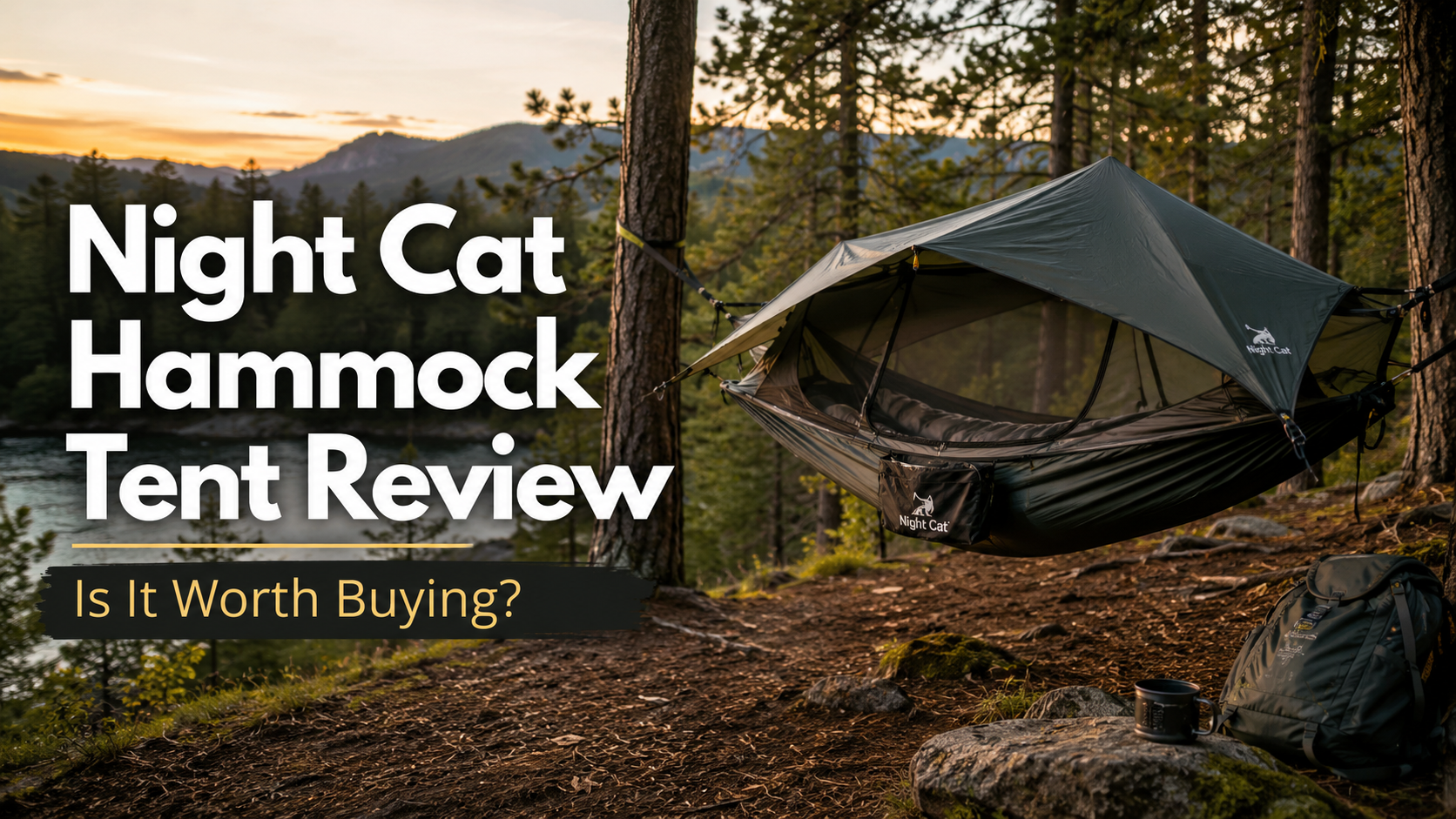
The Night Cat Hammock Tent is worth buying for solo campers who want an affordable all-in-one shelter with integrated mosquito protection, a rainfly, and the option to sleep above or directly on the ground. It is especially appealing for casual camping, motorcycle trips, woodland weekends, and buyers who want more protection than a basic open hammock provides.
However, it is not the best choice for ultralight backpackers, committed side sleepers, people who regularly camp without trees, or anyone expecting the flat sleeping surface of a traditional tent. The standard model is still a curved hammock, and its four-pound packed weight becomes considerably heavier once insulation is added.
Worthflect rating: 8.1/10
Best for: Solo campers, warm-weather woodland camping, motorcycle touring, occasional backpacking, and buyers who want one shelter for both hanging and ground use.
Skip it if: You prioritize ultralight weight, sleep mainly on your side, camp above the tree line, or want a truly flat bed.
Editorial note: This Night Cat hammock tent review is based on the product’s current specifications, construction, pricing, intended use, and documented owner feedback. We do not claim unverified long-term personal ownership.

Caption: The Night Cat Hammock Tent combines a suspended bed, mosquito net, rainfly, straps, poles, stakes, and guylines in one package. Alt text: Night Cat hammock tent with mosquito net rainfly and included camping accessories. Source: Night Cat official product listing.
Night Cat Hammock Tent Review at a Glance
The model evaluated here is the Night Cat Bottom Waterproof Camping Hammock Tent, also listed as model DC-01. At the time of this review, Night Cat listed it at approximately $129.99, although pricing and regional availability may change. The complete package includes the hammock body, built-in bug net, rainfly, two tree straps, aluminum poles, guylines, stakes, carabiners, and a carrying bag. (Night Cat Store)
| Category | Worthflect assessment |
|---|---|
| Sleeping capacity | Best treated as a one-person shelter |
| Open dimensions | Approximately 9 × 4.5 × 1.6 feet |
| Packed weight | Around 4.4 pounds including the package |
| Main material | 70D parachute nylon |
| Weather protection | Rainfly and waterproof-bottom construction |
| Bug protection | Integrated mosquito net |
| Ground use | Possible with the waterproof-bottom model |
| Best season | Warm conditions unless insulation is added |
| Setup difficulty | Moderate for a beginner, easier after practice |
| Overall value | Very good for an integrated hammock system |
One point requires clarification. Night Cat’s specification table mentions a maximum load of 440 pounds, while the product description refers to 330 pounds as the appropriate support limit for one person. Because those numbers conflict, buyers should follow the more conservative 330-pound limit and treat this primarily as a solo sleeping system rather than a genuine two-person tent.
What Makes the Night Cat Hammock Tent Different?
A normal camping hammock usually gives you a suspended fabric bed and little else. You may need to purchase a tarp, mosquito net, suspension system, stakes, and storage separately.
Night Cat bundles most of those components together. The result sits somewhere between a jungle hammock and a compact tent. You sleep above wet, uneven, or rocky ground while the bug net creates an enclosed sleeping compartment and the rainfly provides privacy and protection from rain.
The waterproof-bottom model also has another useful advantage: it can be placed on the ground when suitable trees are unavailable. Night Cat distinguishes this DC-01 version from certain “Hammock Pro” models whose bottoms are not waterproof without an additional footprint.
That versatility is the strongest reason to consider it. You are not buying the lightest hammock or the roomiest tent. You are buying a flexible shelter that can adapt to different campsites without requiring an entirely separate setup.
Setup Experience: Straightforward, but Not Instant
The basic hanging process is familiar: wrap the straps around two sturdy trees, connect the hammock with the supplied carabiners, adjust the suspension, insert the aluminum poles that hold the bug net away from your face, secure the side guylines, and attach the rainfly.
Night Cat describes the system as fast and easy to assemble, but first-time users should not expect a perfect pitch within two minutes. The hammock height, strap angle, tree spacing, rainfly tension, and side stabilization all affect how the shelter feels.
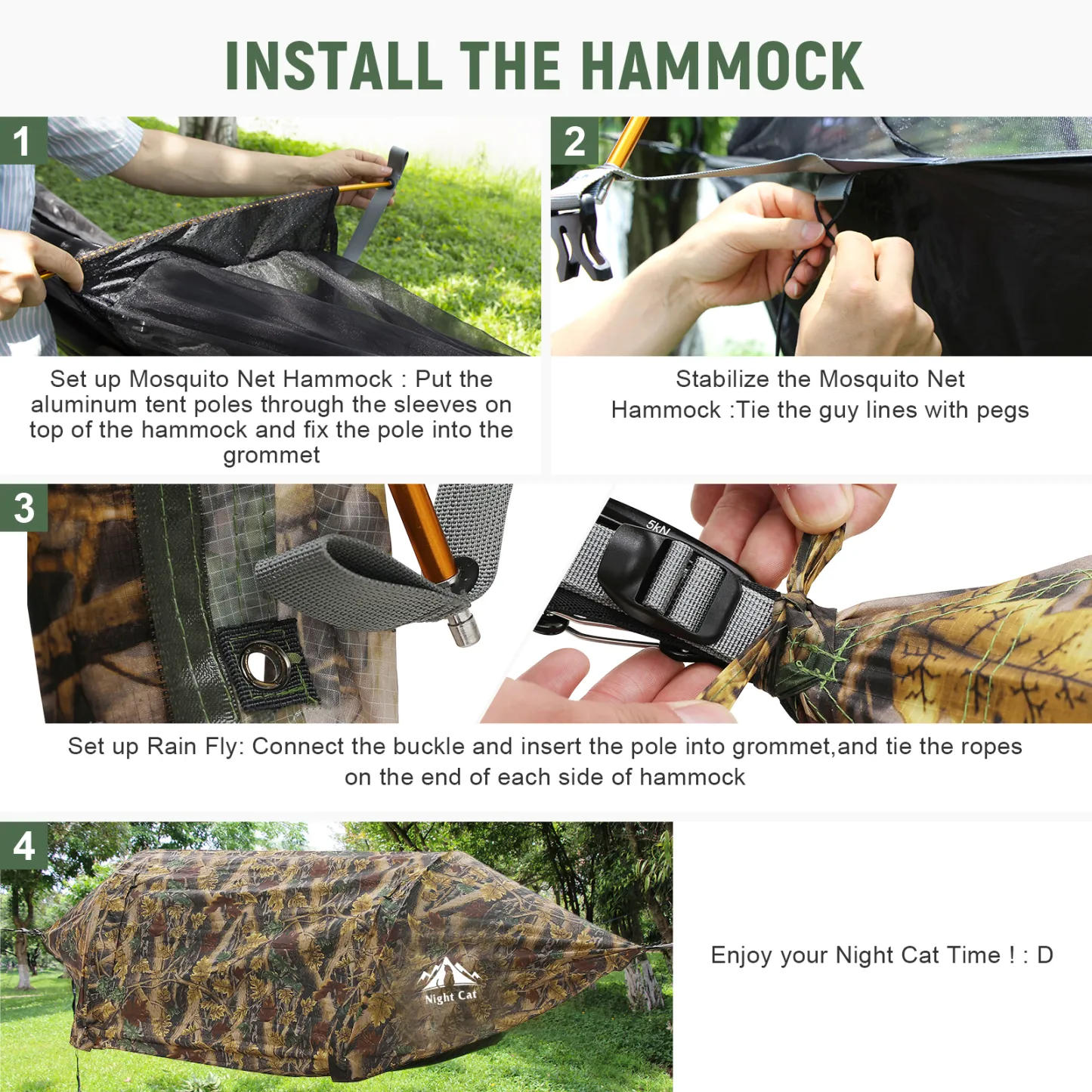
Caption: Setup involves installing the aluminum net poles, stabilizing the hammock with guylines, and securing the rainfly over the shelter. Alt text: Night Cat hammock tent setup instructions showing poles guylines straps and rainfly installation. Source: Night Cat official product page.
The first setup should be completed at home or in a local park rather than after dark at a remote campsite. Practice helps you learn how high to place the straps and how much tension to apply before the hammock becomes too tight.
The included side guylines are particularly important. They reduce excessive movement and help preserve the shape of the enclosed sleeping area. They do not make the hammock completely motionless, but they create a more controlled feeling than an unrestricted recreational hammock.
Ground setup is possible, but it is still a backup configuration rather than a replacement for a freestanding tent. The structure depends on stakes and tension, and there is less interior volume than you would get from a similarly priced one-person backpacking tent. A lightweight footprint would also be sensible to protect the waterproof base from stones, roots, and abrasion.
Sleeping Comfort: Better Than the Ground, but Not Truly Flat
Comfort depends heavily on what you expect from a hammock.
The Night Cat provides relief from rocks, roots, mud, slopes, and hard ground. It also creates a gently supported sleeping position that many back sleepers find relaxing. The 9-foot body gives a solo camper enough room to adjust position rather than feeling trapped inside a narrow fabric tube.
Nevertheless, the standard Night Cat Hammock Tent does not create a flat sleeping platform. Your weight pulls the center downward, producing the familiar hammock curve. Lying slightly diagonally can reduce that curve, but the integrated enclosure and shape limit how far diagonally you can position yourself.
Back sleepers are therefore the safest match. Occasional side sleeping may be possible, but people who spend the entire night on their side could experience pressure around the shoulders, hips, or knees.
Buyers who need a flatter surface should examine Night Cat’s Lay Flat Hammock Tent instead. That model uses additional structural components to create a bed-like platform and is specifically marketed toward back and side sleepers. It currently costs more and weighs approximately 7.7 pounds, compared with roughly four pounds for the standard model.
Weather Protection: Capable When Pitched Correctly
Night Cat lists 4,000-millimeter water resistance for this model and supplies a full rainfly rather than a small overhead panel. The fly surrounds much of the sleeping compartment, which provides better privacy and wind-driven-rain protection than a basic diamond tarp.
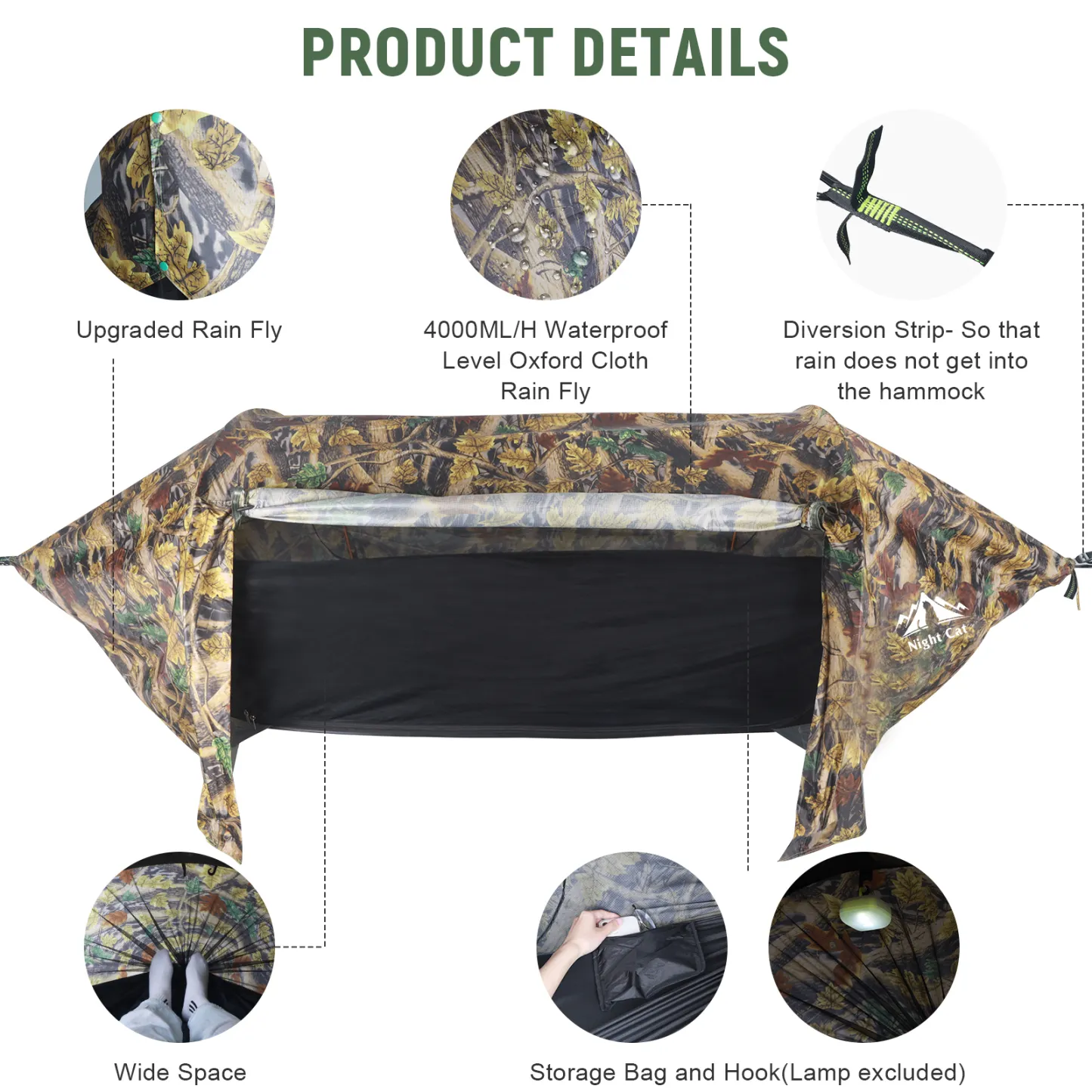
Caption: The rainfly wraps around the sleeping compartment, while the interior includes space for small essentials and a hanging light. Alt text: Night Cat hammock tent waterproof rainfly interior space storage pocket and lamp hook. Source: Night Cat official product imagery.
Its performance still depends on setup. The fly must remain tensioned so water runs away instead of pooling. The suspension should be angled so rain does not travel down the straps toward the sleeping area. Campers should also avoid low areas where runoff collects beneath the hammock.
Condensation is possible whenever a rainfly is closed around a sleeping person. Leaving appropriate ventilation around the entrances can improve airflow, provided the opening is positioned away from incoming rain.
Anecdotal owner reports describe using Night Cat hammock systems successfully in heavy rain and even below-freezing conditions when paired with suitable insulation. Those experiences are encouraging, but they should not be treated as a guarantee because weather, campsite selection, setup quality, and insulation differ considerably. (YouTube)
For normal three-season recreational use, the rainfly appears sufficiently protective. For exposed mountain conditions, severe storms, or winter expeditions, a more specialized shelter would offer greater confidence.
Mosquito Net and Interior Usability
The integrated mosquito net is one of the product’s most practical advantages. It eliminates the inconvenience of arranging a separate net around a moving hammock and provides full-body protection from mosquitoes, flies, and other insects.
The aluminum poles hold the mesh above the sleeper rather than allowing it to rest on the face. This produces a small but usable enclosed space where you can change clothing, organize equipment, or read before sleeping.
There is enough interior space for essentials such as a phone, headlamp, water bottle, or power bank, but this is not a shelter for storing a large backpack beside you. Bulky equipment is better placed below the hammock, beneath the rainfly’s coverage, or hung from the suspension after confirming that it will not interfere with stability.
The enclosed design also improves privacy. This can matter at public campgrounds, festivals, motorcycle rallies, or shared woodland sites where an open hammock feels overly exposed.
The Missing Item Most Buyers Will Need: Bottom Insulation
The complete shelter package does not automatically make it a complete sleep system.
Air moving beneath a hammock can remove body heat surprisingly quickly. A sleeping bag insulates the top and sides, but the insulation beneath your body becomes compressed and less effective. In mild summer weather this may be manageable, while cooler nights can become uncomfortable.
Night Cat sells a compatible underquilt separately for approximately $39.99. The company lists it at 2.64 pounds, with synthetic insulation designed to hang beneath the hammock without being compressed. Night Cat also offers a tent-and-underquilt package that was listed at approximately $179.99 when reviewed.
That additional weight changes the value calculation for backpackers. The shelter package weighs roughly 4.4 pounds, and the underquilt adds about 2.64 pounds. Before adding a sleeping bag, clothing, food, or water, the combined shelter and bottom-insulation system already approaches seven pounds.
For car campers and motorcycle travelers, this is unlikely to be a major concern. For long-distance hikers, it is substantial.
A sleeping pad can be used instead, although pads may shift or create a less natural hammock shape. The underquilt is generally the more comfortable pairing, while the pad is more versatile because it also works when the shelter is used on the ground.
Portability and Build Quality
At four pounds for the hammock itself and approximately 4.4 pounds for the packaged system, the Night Cat is portable but not ultralight. Its packed dimensions are listed at around 18 × 9 × 5 inches, which is manageable in a car, motorcycle case, canoe, or medium backpack.
The 70D parachute nylon is heavier and more reassuring than the extremely thin fabric used in some minimalist hammocks. The package also includes aluminum poles rather than requiring improvised sticks to hold up the mesh.
The trade-off is bulk. Each added feature poles, rainfly, waterproof floor, bug net, carabiners and stakes makes the system more capable while reducing its appeal to hikers counting every ounce.
Careful handling remains important. Users should inspect the straps, carabiners, stitching, connection points, and nearby trees before every trip. Sharp objects should be kept away from the hammock body, and the shelter should be hung only as high as necessary to reduce the consequences of a fall.
Night Cat currently states that its products carry a one-year warranty covering eligible defects through repair or replacement rather than an automatic refund.
Night Cat Standard Hammock Tent vs. Lay Flat Hammock Tent

Caption: The standard waterproof-bottom hammock favors versatility and lower weight, while Night Cat’s structured models focus more heavily on sleeping support. Alt text: Comparison between Night Cat standard hammock tent and Night Cat Hammock Pro design. Source: Night Cat official product comparison.
| Feature | Standard Night Cat Hammock Tent | Night Cat Lay Flat Hammock Tent |
|---|---|---|
| Current listed price | About $129.99 | About $199.99 |
| Weight | About 4–4.4 lb | About 7.7 lb |
| Sleeping surface | Traditional hammock curve | More bed-like structure |
| Tree requirement | Two suitable trees | Additional straps and more complex positioning |
| Best sleeper | Mostly back sleepers | Back and side sleepers |
| Ground use | Waterproof-bottom model can be used on ground | Depends on the exact version and protection used |
| Best use | Versatility and portability | Comfort-focused shorter trips |
The standard model offers the better value for occasional camping and buyers who already enjoy hammock sleeping. The Lay Flat version is the more logical upgrade for someone attracted to suspended camping but concerned about the curved sleeping position.
Who Should Buy the Night Cat Hammock Tent?
This hammock tent makes the most sense for:
- Solo campers who usually stay in wooded areas.
- Buyers who want bug protection and a rainfly included.
- Motorcycle, bicycle, canoe, or car campers who can tolerate moderate weight.
- Campers dealing with wet, rocky, sloping, or root-covered ground.
- Back sleepers who already enjoy the feel of a hammock.
- Occasional users who want one system for hanging and ground camping.
- Backyard sleepers, festival campers, and weekend adventurers.
It is particularly good for someone entering hammock camping who does not want to research and purchase every component separately.
Who Should Skip It?
Consider a different shelter when:
- You are an ultralight or long-distance backpacker.
- Your camping locations frequently lack strong, properly spaced trees.
- You need a completely flat sleeping surface.
- You sleep almost exclusively on your stomach or side.
- You expect spacious interior storage.
- You regularly camp in exposed alpine or severe winter conditions.
- You need a genuine two-person sleeping shelter.
Despite the high load number shown in parts of the listing, this should be considered a roomy one-person system. Two people may be able to sit in it briefly within the appropriate weight limit, but overnight use will be considerably more comfortable and safer for one adult.
Pros and Cons
Pros
- Hammock, bug net, rainfly, straps, poles, and hardware are included.
- Waterproof-bottom model can serve as a ground shelter.
- Keeps the sleeper above mud, stones, roots, and uneven ground.
- More private and weather-protected than an open hammock.
- Relatively strong 70D nylon construction.
- Good value compared with assembling a complete system separately.
- Suitable for car camping, motorcycle trips, and weekend adventures.
- One-year warranty against eligible product defects.
Cons
- Heavier than a basic backpacking hammock.
- An underquilt or sleeping pad adds weight and expense.
- Curved sleeping position will not suit everyone.
- Setup requires practice and properly spaced trees.
- Product information gives conflicting 330-pound and 440-pound limits.
- Interior gear storage is limited.
- Ground mode is less convenient than a freestanding tent.
- Not an ideal two-person overnight shelter.
Final Verdict: Is the Night Cat Hammock Tent Worth It?
Yes—the Night Cat Hammock Tent is worth its price for the right camper.
At approximately $129.99, it delivers significantly more functionality than a basic hammock. The bug net, full rainfly, waterproof bottom, suspension hardware, aluminum poles, and ground-use capability form a practical all-in-one package.
Its limitations are equally important. This is not an ultralight shelter, not a completely flat bed, and not a comfortable two-person tent. Cooler-weather buyers must also budget for an underquilt or appropriate sleeping pad.
For solo woodland camping, motorcycle touring, casual backpacking, festivals, and weekend adventures, the balance of versatility, protection, and price is convincing. The standard Night Cat is the model to choose when you value lower cost and flexible ground use. Choose the Lay Flat version instead when sleeping comfort matters more than weight and simplicity.
Worthflect recommendation: Buy it for solo three-season recreational camping, but add insulation before using it in cool weather and follow the conservative 330-pound load rating.
Frequently Asked Questions
Is the Night Cat Hammock Tent waterproof?
The evaluated model includes a rainfly, a waterproof-bottom construction, and a listed water-resistance level of 4,000 millimeters. Correct tension, campsite selection, ventilation, and strap positioning remain essential during rain.
Can the Night Cat Hammock Tent be used on the ground?
Yes. The DC-01 bottom-waterproof model is designed to function as a ground shelter when trees are unavailable. Using a separate footprint is still advisable to reduce punctures and abrasion.
Does it include an underquilt?
The standard package does not include an underquilt. Night Cat sells one separately and also offers a hammock-tent-and-underquilt combo.
Is it comfortable for side sleepers?
Occasional side sleeping may be possible, but the standard model retains a traditional hammock curve. Regular side sleepers are more likely to prefer Night Cat’s heavier Lay Flat Hammock Tent.
Can two people sleep in it?
Night Cat lists one-to-two-person occupancy in parts of the specification, but the product description also emphasizes one-person use and gives inconsistent load limits. For comfort and safety, it is better treated as a one-person sleeping shelter.



Leave a Reply